So I did an interesting protein experiment with Egg Whites vs Whey

nof1
whey
amino

(Scott Shillady) #25

From Wikipedia

With genetic engineering it became possible to isolate rennet genes from animals and introduce them into certain bacteria, fungi, or yeasts to make them produce chymosin during fermentation. The genetically modified microorganism is killed after fermentation and chymosin isolated from the fermentation broth, so that the fermentation-produced chymosin (FPC) used by cheese producers does not contain a GMO or any GMO DNA. FPC is identical to chymosin made by an animal, but is produced in a more efficient way. FPC products have been on the market since 1990 and have been considered in the last 20 years the ideal milk-clotting enzyme


#26

Good grief…I prefer the rennet from the spleen of an animal than that Frankenstein monstrosity. :smirk:


#27

@Marty_Kendall is a font of wisdom concerning the insulin index.


#28

I tested the Great Lakes brand (green can) during a fast and got no glucose reaction from it. I would suggest testing blood ketones with it as well to be thorough.


(Ross Daniel) #29

thanks for the reply @carolT! I use great lakes specifically. I need to get a meter and test ketones. I just have not made the investment. I just fly keto blind basically.


(barrytspencer) #30

Most know ;o)


(Marcie Budden) #31

I noticed that the whey would react in the same way!


(Stephanie Hanson) #32

Did you just dissolve it in water and drink?


(Richard Morris) #33

Yep, blitzed it in a magic bullet with water and a tbs of melted butter and a pinch of salt (I had added the butter and salt to the egg whites the previous month)


#34

I did use plain water since I was conducting a glucose test. It tastes a little weird, so tea or coffee is better.


(Richard Morris) #35

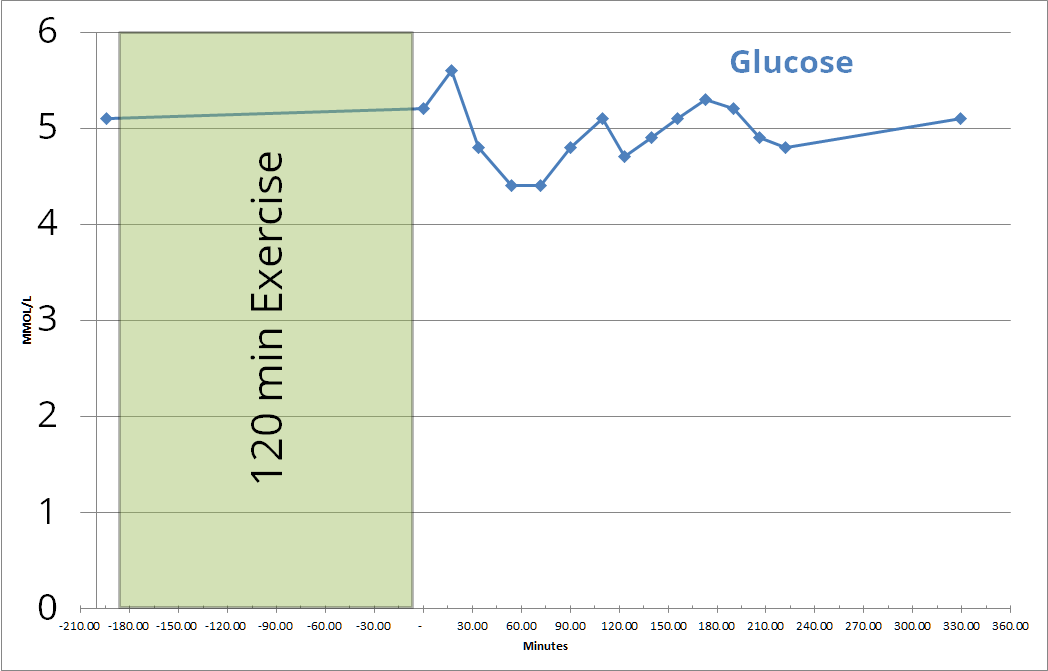
As a follow up to this test, I did a control - fasted 4 days and then cycled for 60k then ate nothing while taking blood tests every 15 mins (roughly). I held off breaking my fast until 6 hours after the ride.

I didn’t get any glucose tests while riding (unfortunately). But as soon as I stopped the ride you can see my glucose overshoot a little - probably because my red blood cells were no longer using it at a higher rate to deliver oxygen. I made a little more insulin in response to the higher glucose and my serum glucose remained slightly depressed for about 60m before it started to head back to my physiological norm (4.8-5.2). Also the low point was 4.4 mmol/l.

Contrast that to 25g of whey which caused me secrete enough insulin to clear glucose faster than I could release it for 6 hours. The nadir was 3.4 mmol/l.

And with 25g of egg white at about 3 hours my glucose started returning back to my physiological range. The nadir was 3.7 mmol/l.

As you can see when I set up my body to have a significant debt in it’s stored glucose (both muscle and liver), if I then eat protein I clear glucose into those sinks faster than I can release new glucose from my liver. Any insulin I make as a result of eating protein gets used immediately to replete muscle glycogen and shows up as a drop in blood glucose.

The other thing I think that we can say is that whey appears to cause me to release a significant amount of insulin for a much longer time.

That’s just in me. I’d be interested to see if someone who was more insulin sensitive saw a less severe glucose excursion (because they needed make less insulin less long).


#36

This is a wonderful discussion. I’ve been looking into the impact that Kefir has on my own diet. Even a half cup of kefir (6 grams carbs) has roughly 50 to 100 times more probiotics than any probiotic supplement in pill form. I concluded, for my own diet, that the kefir, although highly beneficial for gut health, was causing too large of an insulin response. Here are two research articles I found relevant as I did my explorations…

http://lib.dr.iastate.edu/cgi/viewcontent.cgi?article=1381&context=etd


(Richard Morris) #37

Kefir uses whole milk, so unless you curdle it to seperate it into curds and whey, then I suspect you will be getting as much whey from a glass of kefir as you would from a glass of whole milk.

In theory you should be getting less milk sugars because some of those will have been fermented into lactic acid and alcohol by the kefir grains.


(Arlene) #38

I’ve made yogurt and creme freche. I would think kefir could easily be duplicated on your kitchen counter using a few tablespoons of kefir stirred into heavy cream. The end product should have the same good bacteria as regular kefir with much fewer carbs. Just a thought.


(Richard Morris) #39

Great idea


(Jason Fletcher) #41

You are making the assumption here that the stored glucose is depleted. IF you were keto adapted at this point for some time your glucose levels should be no lower then normal. Plus the only way to tap into the stores of glucose from exercise to deplete them at this point is to increase your VO2max. The steady state cardio would not go into using these reserves of glucose only a HIIT workout or heavy lifting would. You also think that by fasting all the glucose would be used it is not. Your body is now efficiently sparing glucose for the HIIT activities. The starting point glucose trends were different before you ingested the protein. After one workout they were going down and after another they were going up. The intensity of the workouts could have been different. I don’t know but if they were the same. It would make since to see a increase in glucose in the blood if your intensity was higher. From a higher vo2max and also increased adrenaline during the workout that would push the glucose into the blood for use. There are other factors that could affect adrenaline and glucose as well. Such as your song selection during a work. Whey does have a greater insulin response. But their are two factors to account for the rate of absorption and the amino acid profile. The other question that this brings up is the goal of eating protein? Lean tissue mass and strength. Gram for gram due to the amino acid profile Whey is a better choice and study’s do support this. Does the insulin response of whey negate these benefits? This i think depends on the person and goals. Eating to satiation is not a option when eating whey protein shakes.


(Richard Morris) #42

Thanks for the comment.

I was instrumented for the first 2 rides using a Microsoft Band which was supposed to be able to measure (or approximate) V02 max but I was never able to get it to switch into that mode despite several times doing hill sprints on my bike to collapse. The manual says - hey do a hard workout a few times and we’ll get a baseline. I have since tossed the Microsoft band, and it seems that Microsoft has given up on it too.

For what it is worth I did 2, 3 and 4 circuits respectively (Egg white, Whey, Control) of lake Burley Griffin which contains several sprint points and a hill climb. But yeah that was confounded by the difference in the challenges.

To really test properly I would have to be on a stationary bike and properly instrumented. You are correct that I assume by fasting for more than 3 days that I would have made a whole in my liver stores of glucose, and exercising in that state for several hours would have made hole in my muscle stores.

I didn’t expect that all my stored glucose would be depleted, just a sufficient hole to give me a rough proxy for circulating insulin.

I observed a difference in how long my glucose remained depressed after eating whey compared to egg white and to eating nothing after exercise both in duration and degree.

I totally agree.

I agree this is contextual to your goals. Mine are to lower chronic insulin, to reduce resistance to it, so I can lower secretion. And in my circumstance I make a lot for a long time - so I likely have to work on that more than most. Anything that provokes a strong insulin response borks satiation signalling and the more IR they are the more that is the case - so yes we agree vigorously here.


(Jason Fletcher) #43

How was your satiation signalling during this Whey vs. Egg. Where you able to recall feeling more hungry from the whey? What did you feel like before you consumed the egg vs whey? I did remember finding something that Whey could be satiating but I do not remember how the experiment was setup or what the exact findings were. I have always made the assumption that foods that will spike insulin will make you hungry. So whey by doing so would by default make you hungry. But i wonder if there is another factor when it comes to whey that could counter the hunger created by the quick drop in blood glucose. Or if whey has other property’s that increase insulin sensitivity even in contrast to its high insulin response. Does a high increase in insulin from the amino acids without added glucose help in the long run with IR? Another question is what is your body doing during the time that your blood glucose is low from the insulin response? I would think at this point it would be forced to work as hard as it can to balance your energy needs. We would think that with high insulin levels this would stop the oxidation and use of fat and ketones production. So at this point you body would be dumping glucose from muscles and liver to balance this energy need. The same thing here happens when you do HIIT exercises over 80% of your VO2max(lower depending on condition of your body). From what i have found is that HIIT exercises help increase insulin sensitivity during workout and over time. I think when your body is in a high glucose demanding state without ingested glucose it conditions your body to become more effective at glucose uptake along with increasing its ability to burn fat at higher levels of your VO2max. . One major difference with HIIT exercise and ingestion of whey would be adrenaline level. This is one thing that does push down hunger. I understand as well that eating large amounts of fat or any energy source right after a workout would not be wise if weight loss is the goal since your body would be most capable at this time to store the energy. Plus you would most likely stop short the mechanisms that are increasing insulin sensitivity. Whey from this line of thought taken after the workout could possible extend the window of time the body is in this state and further increase insulin sensitivity. I guess you could see once adrenaline is lowered you would be starving and over eating could be a factor. But another interesting fact is that adrenaline remains elevated after HIIT workouts longer then steady state this i believe also accounts for the higher BMI after HIIT up to 48 hours. One thing I find contrary about HIIT workouts is that it increases insulin sensitivity in spite of having high insulin levels. Jason Fung states that by lowering insulin by fasting you increase insulin sensitivity. Increased insulin causes insulin resistance. This can not be fully true if you can have a high state of insulin with a HIIT workout and increase insulin sensitivity. There has to be another hormonal factors involved. I wonder if this other factor also could possibility related to whey proteins ability to increase insulin sensitivity in some study’s.


(Richard Morris) #44

It’s more likely the opposite. When I say my insulin went high after the challenge, I didn’t mean secreted into general circulation to cause mischief, but rather secreted and used to get glucose into depleted muscle cells. So each molecule of insulin engaged translocating GLUT4 in a muscle cell meant one fewer to bind to fat cells to inhibit lipolysis, or to liver cells to inhibit the spilling of ketones.

I suspect the apparent paradox comes from conflating the acute and chronic effects of high insulin.

Leaving aside it’s primary role in moderating lipid supply from storage, Insulin is a signal to tell peripheral cells to translocate high speed glucose transports (GLUT4) to the cell wall to rapidly draw down circulating glucose.

Acutely more insulin means more GLUT4, but chronically more insulin means less GLUT4 as cells gradually protect themselves from gluts of energy by developing a protective resistance to insulin.

You can use this analogy; you walk into as silent room and whisper and other people can hear you. Once everyone starts whispering the ambient noise level rises and you have to speak louder for the same effect. Speaking louder is the acute effect of more signal. The fact you needed to speak louder is the chronic effect of more signal.

The problem for someone who has been deranged is anything that provokes insulin causes us to make more for longer … sticking with the same analogy we’re walking into a quiet room with mild tinnitus so we have to ask people to speak up all the time. Enough time in quiet rooms and we may slowly become more sensitized. If we spend time in loud rooms the tinnitus gets worse.


#45

@richard , I did something similar with a triathlete friend. He had a similar reaction to yours (Blood sugar dropped). Mine had the exact opposite reaction - it went up.
http://lowcarbstudies.com/blog/2018/03/29/blood-sugar-responses-compared/
My blood sugar took hours to stabilize. His stabilized pretty quickly.

@richard I am curious about your podcast intro. You say that all signs of disease are gone but I’ve also heard you state that your Fasting Insulin is high. That would suggest that at least one of the markers of Insulin Resistance is still present. Is that a concern for you and what are you doing to try and reverse that? Would further weight loss help? (I know you and Carl both say weight loss isn’t necessarily your goal). I know you ride your bike quite a bit so that sort of intervention seems only so helpful in your case.