Lifelong protein restriction


(Bob M) #1

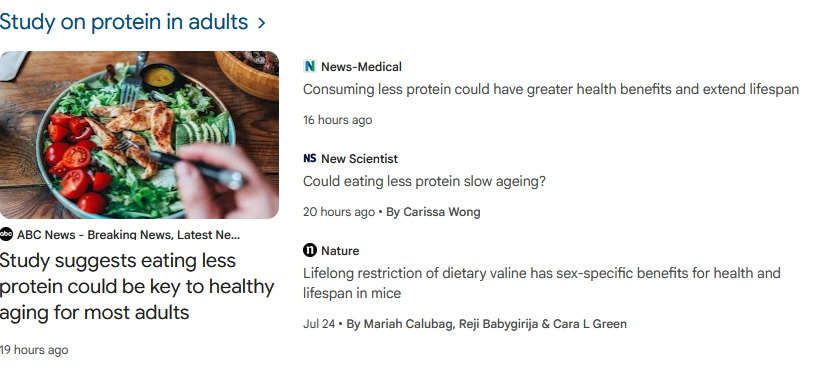
The headlines:

The VAST majority of this is in mice. Not humans.

The study, in mice:

https://www.nature.com/articles/s43587-026-01169-0

The garbage just keeps going:

image

From here:

I eat as much protein as I want to, and my last HS-CRP (high sensitivity c-reactive protein) was 0.5, and the previous one was 0.2. That’s low. I have other blood inflammatory markers that are also very low. While eating as much protein as I want to eat.


#2

YUP! They’re not fooling anybody, other than themselves at least.


(Central Florida Bob ) #3

It would be interesting to see a meta-analysis of all these studies done in mice and how many replicate in humans. In general, I’m not even sure they replicate in other mice.


(Doug) #4

Indeed, Bob. If we are to note or look for causes of inflammation, obesity, etc., then pointing the finger at protein is junk science, and hilariously so. (In my opinion.)

That last one - “Cell Press Blue”… ‘Cell Press’ and the like are often destinations for many papers that aren’t fit for other places.

Cell Press Blue: “Discounted Article Publishing Charge (APC): Free. This discount is valid for articles submitted by 30 December 2026. Full APC without discount: USD 7,000 (excluding taxes).”

It’s ‘pay-to-publish’ but it’s free until the end of the year. :wink::smirk:

The original ‘Cell’ magazine started 50+ years ago - part of MIT Press in Massachusetts. ‘Cell Press’ was an attempt to capitalize on the name similarity. I’m also not saying there necessarily never was anything good about it… Who knows?

Now, all the above are owned by Elsevier, a big publishing company, and everything is mixed up and (IMO) heavily bastardized.

So much of it all - both the good and the bad - is related to money. Anybody, saying anything, can be “published,” now. If I’m wanting some grant money, me having been ‘published’ means my chances of getting the money are increased.

I’m certainly viewing it with a jaundiced eye, here, but the entire spectrum of ‘peer review’ and things being published because of money, or for money, rather than their true merit - has become a big mess.


#5

Let’s suppose I am a naive one and believe the articles. My take is that we shouldn’t be sedentary :smiley: I am all for that, it has so many benefits.
(Yeah, I am so interested in the lifespan of flies with reduced protein intake…)

I don’t like overeating protein though, it’s wasteful and beyond some point unhealthy. Oh and I stay fat. But that’s me.
Of course, my definition of overeating protein is probably vastly different from the ones who are in the “less protein is better” camp but I don’t even know about their idea, skimmed the articles but stayed clueless.
And if I could ever undereat protein (not true), I surely would stay fat. I am starving below a decent amount and even massive overeating of calories can’t help with that. I trust my body to know what it needs.

Oh and I wouldn’t want to make my life longer on a super miserable, impossible low-protein diet… But I probably would live much shorter. Bad deal.


(KCKO, KCFO 🥥) #6

So glad I am not a mouse then.


(John) #7

Next up… A study of succulent watering restriction determines that we’ve been over-hydrating and would extend our lifespan by limiting intake to one glass every other day.


(St) #8

I used to work in a university lab, biology department. Restricting calories was a sure way to make animals live longer. Restricting protein had a similar impact - it was assumed it forced more apoptosis. I didn’t realise it wasn’t published back then though - it was known to extend the lives of mice and then my colleagues used in aging studies in insects like fruit flies and crickets. They were studying aspects of aging like learning and behaviour, rather than trying to make invertebrates live longer, that was already a known technique.

I’ve assumed it’ll be the same for people too. Not necessarily anything wrong with eating protein till it’s not limiting muscle growth, but may not be optimal for longevity. Also better than being flabby, having low muscle mass or fragile bones!


(Doug) #9

It’s an interesting conversation.

‘Life extention,’ per se - yes - very likely related to eating ‘less.’ Although there’s a wide range there - for most of us reading this forum, we had problems with eating “too much”, period, or eating too many carbohydrates versus proteins and fats.

I realize it’s generalizing, but I think for most of us, getting the carbohydrate/insulin/metabolic syndrome/diabetes thing under control or prevented is huge. After that, if we rationally end up thinking that perhaps there is a “too much protein” point, okay, may be, but the lion’s share of the work has been done, and the benefits are accruing already.

Finding one’s own best place in all this…? I was never a regular weight-lifter. Always have done fairly heavy work, pickaxing trenches in hard, rocky soil, cutting trees, cutting them up, moving it all, burning them, construction, renovation, brick, block, stone, lumber…

Always felt okay, in the main, and felt strong. Now I’m 67 and beginning to see muscle loss. Probably was happening but never noticed it - now, it’s there. Not at all a big deal yet, but it’s apparent.

I see an 89 year old and a 93 year old all the time. While not truly catastrophic, loss of strength and balance for them is a major thing - it defines much of their lives now, sad to say. Not the end of the world, and life is complex - on a happiness scale of 0 to 10, one is likely an 8 (the older one) and the other a 5 or 6.

Personally, I really need to start lifting weights or something - and it’s a matter of overcoming my laziness and habitual nature. Always have really sucked at making needed changes, even if I absolutely agree they’re necessary.

On the ‘protein restriction’ thing - it seems so very far away. I don’t know that it’s really a straightforward equation, but I’d gladly risk “too much protein” and any possible life reduction (which I don’t think is substantial, if a thing at all) if it means any gain or less loss of strength, if it helps me be able to continue to do the things I want to.


(Bob M) #10

That’s why I do a lot of body weight training. For legs, I’m on one leg/foot a lot. It’s more for balance than strength.

And I’m 62, but I don’t see any real improvement. Small amounts maybe. But nothing like when I was younger.

So, it’s more a matter of maintaining what I have for as long as possible while being able to move around.

Personally, I doubt reduced protein is a good thing, particularly because we supposedly absorb less as we age.

Similarly, while the idea of eating less causing longer life seems reasonable, to what end? I’d rather have birthday ice cream cake with my kids than forego that so I can be in some type of calorie “deficit” (and is it a deficit if you’re maintaining the same weight?).


(Edith) #11

Interesting article, but I don’t think is really says anything new by the end.

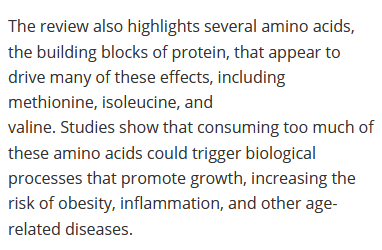
Studies show that consuming too much of these amino acids could trigger biological processes that promote growth, increasing the risk of obesity, inflammation, and other age-related diseases.

What is too much protein?

“These studies show that the amount of protein sedentary people are eating today may have negative health consequences, at least at the population level,” Lamming says.

Is it really the protein or the fact that they are sedentary?

Lamming notes that athletes often consume large amounts of protein without developing metabolic diseases. He suspects that regular exercise, perhaps by using protein to build strong healthy muscles, helps protect them from the negative health effects associated with a protein-rich diet.

Hum… people who eat a lot of protein and exercise are metabolically healthy. Huh, whaddaya know about that? The large amounts of protein actually help them build strong, healthy muscles.

Maybe protein/calorie restriction works in the lab for smaller life forms such as mice and fruit flies., but the lab is an artificial environment. How about calorie restrict a mouse that lives in the wild? Cut back its calories and protein there, and it will probably have shorter life, because it won’t have energy to look for food or escape as readily from a predator. So, do these lab experiments, where the mice are nurtured in a safe environment and don’t have to search for their food, truly relate to the real world? Moreover, maybe sarcopenia doesn’t matter as much when you walk around on all fours and don’t have far to fall.

As far as people are concerned, I don’t believe it would translate. How many elderly people have their lives shortened because they fall and break something? It is a lot, and falls are the leading cause of injury-related deaths. Also, we live way longer than fruit flies and rodents. Can those kinds of experiments in animals that live from months to a few years, really translate to animals that live decades?

Anyone over the age of 70 here can correct me, but it seems to me that as people get older they do tend to eat less, maybe the taste buds aren’t as sensitive and food has lost some of its appeal, and due to aches and pains they are more sedentary. That is a recipe for frailty. Like @OldDoug mentioned above, I would rather eat my protein, lift my weights and be sturdy, than be frail and afraid to fall.

My dad is going to be 90 this fall. He is decrepit,sarcopenic, and has a hard time getting around. He has lost 5 inches in height over the years. I can tell you that his low protein, high carbohydrate diet has NOT done him any favors. You could say, “Yeah, well, he made it to 90,” but it is a miserable 90.

“We probably need to personalize protein recommendations based not just on age, but also on how physically active people are.”

This final sentence kind of says it all, “Eating a lot and not exercising is bad,” or to put another way, “If you are sedentary, you don’t need to eat as much.” I don’t think this is new.

I think I’m done ranting. :crazy_face:


(Edith) #12

Exactly! All you have done is slowed your metabolism.


(St) #13

I’m pretty certain that being in ketosis some of the time is good. Certain that maintaining muscle mass, strength, bone density, balance and activity is essential. There’s great evidence for also maintaining an active mind, good sleep, sense of belonging, purpose, joy, etc.
After that, lower calorie intake, some time in a longer fasted state (more than overnight or a few hours) and probably lower protein are probably beneficial. How much? - not so over done that that you can’t function. If I’m exhausted and skipping the gym, light headed, loosing muscle, endurance or strength, feeling obsessed with food, can’t sleep, feeling depressed, anxious or giving up celebrations with friends and family, something had been over done. Eat! Live and be merry :wink:

It may be a choice - like how professional athletes typically die younger than non competitive sports players. They’ve perhaps overdone it?
If bulking up is the key aim, then hit the protein, build the muscles. I’ve not seen studies on body builders longevity, but I expect that eating protein to that extent is probably not optimal. Most people I know who’ve been active into their late 80’s and 90’s have been fairly average build to lean and decidedly active of mind and body. More short than tall also (maybe it’s like dogs?).

Those who are obese, going to be better to eat the bacon and steak than eat the chocolate, but may not be optimal.