Why is it good if BG levels drop (=insulin rise)?


(Keta) #1

Hello, I am new here, and loads of question. I try to answer them by searching the forum or the web, but so many information, so many opinions. So here is a starter question for the relation between blood glucose (BG) and insulin / ketones.
Why is it good, or considered so, if BG levels drop - as this indicates insulin? Say BG at
T0=6
T1=6.5
T2=7
T3=6.1
T4=5.5.

Drops at T3 and T4 are indicative that a lot of insulin has been produced, rapidly. Why is this good if low insulin is what we sek to achieve (I take this as the premise of keto).
Is the assumption that the same insulin was also active at T1, T2 - only without being so effective?

Imagine there is a med to donw regulate insulin, we would probably see high BG, but less insulin, and take that as a good sign, right?
Can someone explain?
Thanks!


#2

Traditionally that is seen as everything working as intended, but it leads to obesity and diabetes, and you’re unlikely to find anyone on this forum that considers it good. Here in keto land we never put the sugar in to start, thereby allowing insulin to go down.


(Solomom A) #3

High blood glucose has correlated with all sorts of diseases, so if it goes up after a meal and the body can bring it down in good time, then it’s good. You are not bathing your organs in high blood glucose.

High insulin too has correlated with all sorts of diseases, may be more than blood sugar. But if it rises only when you have high blood sugar and is able to lower it in time, then falling back to safe levels, then you have peace of mind.


#4

I am not sure I completely understand the question. I work in DL (divide by 18)

Normal fasting BG is ideally under 90. If you have carbs it will depend on how many you have. A Sad meal will raise BG up to 140 (which looking back now is a huge rise) after up to 1 hours but is considered normal. In a keto meal with a few carbs you can still expect a small rise, lets say about 20 points (again divide by 18 for Europeans). After 2 or 3 hours there should be a return to baseline. If glucose goes up by this amount and returns it is normal

One of the signs that you react to an artificial sweetner with an insulin surge is that BG goes down from baseline. This means you are producing a disproportionate amount of insulin. This assumes you take a small of sweetner in water and nothing else


(Raj Seth) #5

If BG levels drop due to insulin spike - not good
If BG levels drop because you’re not spiking them with Carbs, and the BG is all coming from gluconeogenesis, which is mostly a demand driven process - then it is good


(Dameon Welch-Abernathy) #6

It’s both an issue of frequency and amount when it comes to insulin spikes.
Anything you eat/drink will spike insulin to varying degrees.
The way you reduce frequency of insulin spikes is to reduce the frequency of your meals.

If you’re truly not consuming any calories during the day, then assuming your energy expenditures are realatively stable, your blood glucose should be stable as well.

If your blood glucose drops and you haven’t eaten in 24-36+ hours, that is likely because your body has finally burned through your glycogen stores.

If you eat something and your blood glucose drops after an hour or two, that’s a good sign whatever it is you ate causes a greater than expected insulin response.
This includes eating/drinking something with a non-caloric sweetener—individual reactions to these vary.


(Chris W) #7

Here is my take on your question.
BG is related to expenditure and intake/production/storage of it.
I will note I am american so I don’t understand outside mmol so much, but my understanding is you are starting on the high end and ending normal to high(for carb burners) in this example. Also the time frame is somewhat relevant as well as IR levels and normal resting glucose levels.

Given you are not saying that there is a expenditure you are always using a basal amount, if you are ketogenic or not. In your example you show BG going up(presumably from intake of carbs) then down over time below a basal level(also presumed), that can be from one of 3 things happening.

1st you are using the glucose for work in your cells, nothing strange here happens 24/7, if that is because of increase in output(exercise for instance) then there most likely is not a gigantic spike in insulin. Your intake of glucose was probably small or very slow acting carbs. If you are fully ketogenic typically this means very little, the spike may have shut off keytone production briefly until the levels stabilize agian. This would be more along the lines of carb loading before a work out.

2nd you are trying to store the glucose because the level has reached a point a which you are no longer safely using it, now you will see a spike in insulin to clamp it down and store it. This will in invoke liponeogenosis, and shut down keytone production if it was working. This would be the classic store the fat mechanism. The example you are showing seems most like this model. This would have involved recent intake of carbs as well I would say more like a typical meal of a high carb diet.

3rd you are not in taking any external glucose(in the form of carbs) but have had sudden demand in glucose(this would not be a typical ketogenic person) via exercise or hormones. So now you are invoking the liver to release glucose into the blood stream, and increase gluconeogensis, however this is typically regulated and should not reach a point to were insulin clamps down and starts up fat storage process. This is were the time frame is relevant as this would be a very short time frame. This is were IR may come into play with some people though and were the basal amount is important. For me this would be a horrible spike, as I am near 4.0 on that scale most of the time, for my diabetic dad it would be actually fairly low spike.

As others have said both insulin and glucose are related to major diseases keeping them low is beneficial long term.

(Keta) #8

Thank you for your elaborate answer! May I ask you a further question about possiblity 3?
The curve is actually real, timeframe is T60, T90, T120, T180 for an almost no-carb meal. I observed the same curve also another time when I did the testing. Both meals were no-low carb, but had protein (fish). So I wonder if this is gluconeogenesis for protein. Perhaps the digestion etc takes time, 90min sounds reasonable, and as there is no glucose, body transforms proteins into glucose. Can this be the case, or is a glucogenesis profile-pattern different? You write sth about time-frame.
My question: What do you mean by “is typically regulated and should not be so high” and the clamp down process. Is there are term for this, where can I learn more about it?
Thanks so much - this seems a great community!


(Keta) #9

Thank you! The spike is not from carb. I suppose it comes from gluconeogenesis. Why is that good with respect to ketosis? Isnt it just another hurdle? Hurdle 1: body burns carb-glucose, hurdle 2: body produces new glucose, and only when that is gone, ketosis sets in - right?


(Dameon Welch-Abernathy) #10

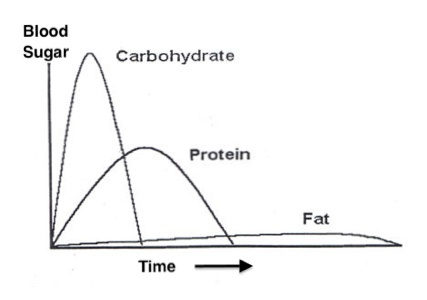
Protein has an insulin response, but it is somewhat delayed and lower in amplitude compared to, say, carbohydrates.

image

Since there was little or no carbs in your meal to counteract, your blood glucose went down.
It’s perfectly normal.


(Keta) #11

Ok, and is the spike then due to gluconeogenesis via proteins? Is 90-120min a realistic window?
Thanks also for your other answers, especially the time-in-between meals seems important.


(Dameon Welch-Abernathy) #12

That’s what I surmise, at least.


(Chris W) #13

To answer your question most likely no it is not gluconeogenisis you are seeing. The process itself is happening when ever you are not eating, or after several hours(typically 4 hours for digestion) or when you need to bring your basal glucose up some from a increased demand as I mentioned with insulin low. If you have digested the fish in this case after several hours the amino acids are coming available later on and if the body decides you have to many it will invoke gluconeogensis if other pathways have not used the amino acids first. GNG is not specific to protein either it will use other substrates. If you are in ketosis this invokes other processes as well, the ketones are floating around in your blood, and GNG will not work with ketoneogensis to any great extent it seems to be one or the other, GNG seems to take priority over ketosis under normal eating(SAD) and if your ratio of insulin to glucagon is lower (keto) than ketogensis will remain in effect as well. Fat adaption also plays into this some, the father along the less you most likely see the drop in glucose since your cells can pull from fat as well.

Dameon had it pretty correct what you are seeing is the insulin response to the meal. Hormone signalling is pretty incredible and really complicated. There are a number that play into how and when insulin is released, insulin in of it self is rather stupid more like a powerful bully if anything. Food simply hitting your stomach, something sweet hitting your tongue etc.
Other things are happening all the time though, your digestive system is working harder so it may require glucose. I will give this my best shot I am still learning and by no means a biochemist.

Gluconeogensis (from my understanding) will not release enough glucose into the blood to cause insulin to spike high enough cause the fat storage mechanism to kick in the liver(aka spike insulin this is the regulation part) Insulin is inverse in proportion to glucagon which is also produced by the pancreas and signals the liver to turn GNG on. So if keto and insulin is spiked due to an influx of protein you will see your blood glucose drop some, once that spike goes away your glucagon will increase and your liver releases glycogen, and produces glucose if needed to keep the blood basal level. It is regulated by insulin(high=off low=on maybe) and glucagon.
The glucagon to insulin ratio determines a lot of what will happen when you intake protein and how the body will react. The higher the ratio the more the reaction will be to insulin (storing) and less to glucagon starting the GKG and keto processes.
There is also glycogenolysis which breaks up the glycogen from triglycerides based on epinephrine levels(emergency).


(Dan Dan) #14

" sweetness itself is not sufficient to start the cephalic response. An unflavored artificial non caloric sweetener by itself did not stimulate insulin secretion. However, when paired with flavour, it may start the the cephalic phase, even if the gastric phase does not proceed (because it has no calories or bulk)."

https://idmprogram.com/cephalic-phase-response-hunger-fasting-18/