New Lingo data sensor


(Bob M) #1

Trying the new Lingo continuous glucose monitor. The first day:
image

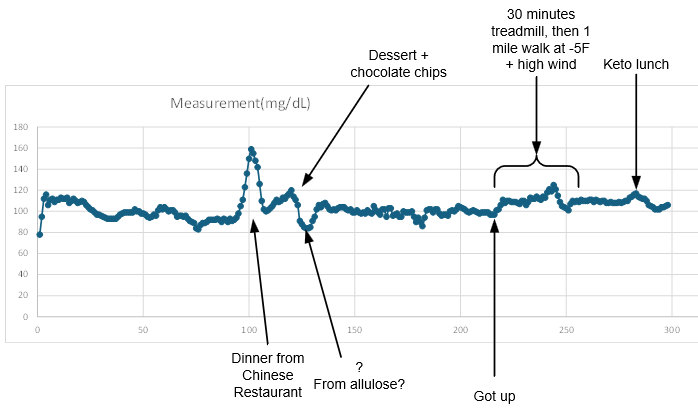
Dinner from Chinese (really, Asian) restaurant: I did have a small amount of rice in one sushi roll. Egg drop soup + Thai beef and Thai chicken. You never know what’s in this stuff, unfortunately. I don’t do well with cornstarch (might be in the soup).

The dessert is chocolate semifreddo, where I replaced (most of) the sugar with allulose. But I did add some (real) chocolate chips.

Not sure why there’s a dip. Maybe allulose?

No breakfast, watched a show, then 30 minutes treadmill, 1 mile outside at -5F with high winds, to walk the dog.

Keto lunch was thin steak, and some beef/butter/cheese/cabbage keto meal.

When you export the data, you get this: 2026-02-07T11:38-05:00, for each sample. If anyone has experience with Excel and can tell me how to convert this to date, time, or even just time, I’d be appreciative.

For set up, it won’t let you go past a screen where you have to enter why you got the device. I chose “mental clarity” or whatever it was. You can’t say you eat 2 meals a day, and it wants to know when you eat 3 meals.

It “grades” spikes. So, I have 3 spikes with grades of 11, 8, and 15. The 11 is the dinner, the 8 is the dessert, and the 15 is from the odd plunge then rise. It takes into account the height and length. To me, the 11 (dinner) should be rated the highest, but the “spike” after the dip (from allulose?) is rated the highest, I think because it “lasts” the longest.

I think the idea is that you set a goal number for spikes, and try to hit that goal. The goal selected is 60/day. I’m assuming you can change that.

But since I’m going to fast next week, I’ll be waaaaaay under that.

The “healthy” range is 70-140 for blood sugar. I expect to be under 70 in a 4.5 day fast. When I eat keto, I should have zero spikes. I’ll have to see what happens.

I haven’t compared the values to my pinprick monitor. I figure that’s a futile exercise.

I think data taken every 5 minutes might be too much. Makes it look ridiculously busy.

If you have questions, let me know.

#2

Seems you recovered real fast from that, that’s awesome! I don’t even bother caring about spikes, spikes don’t hurt us, not recovering from them does!


(Bob M) #3

@lfod14 I’ve often wondered about that. When you look at recommendations for measuring blood sugar, they say to take readings at 1 and 2 hours after eating. For me, that means that I’d be back to where I was, because I recover in 1 hour. The first time I realized this was in 2017, when I wore a CGM I imported from Sweden. That showed that I also recovered in an hour.

But I also wonder if I am producing more insulin than I should, and that’s what’s causing me to get back so fast? I did have a Kraft test a while ago (measure both insulin and blood sugar over time), where the insulin after 2 hours wasn’t too bad. I’ve tried to get another Kraft test, but no one offers them or even knows what they are.

I was following someone on Twitter who gave a Kraft test to her client (she was a psychiatrist), and he had great blood sugar control, but that’s because his insulin was out of control high.

Even if I could find a way to get a Kraft test, if my insulin is higher, what do I do? I’m not sure.

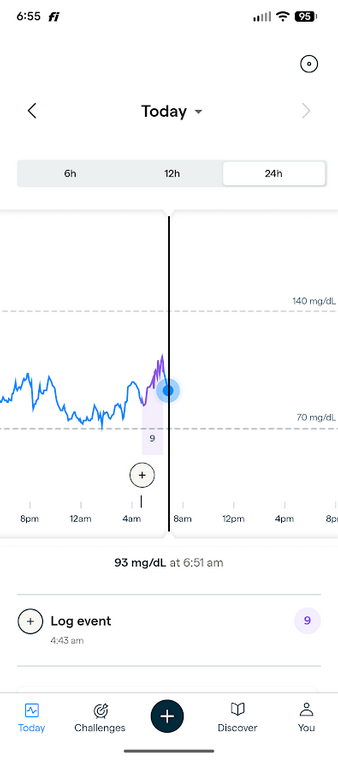
Anyway, here’s a problem this this interface. Here’s what my phone showed this morning. It graded a “spike” and gave it a value of 9. I took a shower, then took my dog for a walk outside in 5F degrees. I didn’t eat. So, that “spike” isn’t a spike due to food:

And is my blood sugar really going that low at night? And those two bumps around 8pm are from mainly high fat meals (sausage + bacon on hot or mild peppers), but with a few chocolate chips in some yogurt, while watching the Super Bowl. From 103 to 82 back to 101? A low of 73 at night.

The CGM I wore in 2017 I think took readings every 15 minutes, so I think it “smoothed” things out between readings. Readings every 5 minutes just seem to make things so shockingly rough.


(Central Florida Bob ) #4

Maybe.

How does that get into Excel? Is it a CSV file (Comma Separated Variables)? Are you using “real” Excel (Microsoft’s) or a clone? The advantage of a CSV file is you can typically edit those in any text editor. So it seems more like a text editor question than what Excel does.

Which means you get into what the spreadsheet looks like and how it displays.

A date in my CSV files most often looks like MM/DD/YY, but if I go into your
2026-02-07T11:38-05:00 and just use “search and replace” to tell the text editor to search for “T” and replace it with “,” the date reads in as just the 2026-02-07 and the next cell says 11:38-05:00. If you want to convert it to just time, in the text editor, you could tell it the T is a divider, and divide it into two columns. Once it’s in two columns delete the one you don’t want.

If you don’t need to import the date, you can just delete the first column in the file you’re importing.

Hope that’s helpful.


(Bob M) #5

Thanks, Bob, I’ll try this at some point.

It gets sent from somewhere to my email as a CSV file. I could edit in a text editor, then pass it into Excel. That’s a great idea.

I think I would need date and time, but I’m not sure. I’ll have to mess around with the graphing tool in Excel.

Apparently, it takes data every minute but then averages over 5 minutes.


(Bob M) #6

Hmm…I’m fasting and yesterday was my first day. At night, I apparently had a low glucose event (edit: overnight), and it won’t read less than 55. It just says “<55”. That sucks.

Edit2: Oh yeah, since I normally take pinprick blood sugar in the morning and at night while fasting, I decided to continue that. So far:

Night: pinprick: 80; Lingo: 72
Morning: pinprick: 98; Lingo: 81

There’s at least a 15 minute difference from your blood sugar to the arm, but one would assume that wouldn’t matter when you’re not eating. But this is why I said it’s a useless endeavor to compare pinprick and CGM readings – you have no idea what the actual reading is. When I had the other CGM (can’t remember the name now), my pinprick readings were higher, very similar, or lower than the CGM’s readings.


(Jane) #7

I just ordered a pair of Stelo’s to try and should have them in the next few days.

When I wore CGM a few years ago I would usually get the low glucose alarm at night. It read 15-20 units below my Keto Mojo but was consistent so I was ok with that since interested in the trends, not actual numbers.


(Bob M) #8

Let me know how they work, because the Stelo’s I ordered had a high failure rate (2 of the 4 failed within a few days).

The app has “fuel with healthy fats”, and it actually says to use saturated fats from eggs, butter, and dairy. It also says that “healthy fats” increase your energy levels and keep you full.

Never thought that’s what it would say.

Now, they still have meals like “turkey meatballs with herbed orzo and simple Greek salad”, so it’s not perfect. They do have a low carb recipe, though.


#9

Not sure how much of a thing that is, if you never have hypo issues, I’d think you’re not. I think that’s more of a thing with bad insulin resistance when your pancreas keeps dumping it then it starts working after there’s already too much. Then think of things like all the GLP1’s that make us produce more insulin on purpose, seems to be all benefits minus the original people that were completely overdosed on them by their docs and had GI issues.


(Bob M) #10

I’m not sure who is writing the notes that appear on my app for the Lingo. But the note today says “Good morning, Robert. Have a low-carb, high protein breakfast to start the day strong.”

Whoa…


(Central Florida Bob ) #11

This is the part that puts the “Looney Toons” question marks in the air over my head,

Night Lingo is 90% of pin
Morning Lingo is 82.6% of pin

Since we don’t know if either one is right, all we can do is compare. I’d expect them to be the same except for some minor differences in test strip to test strip in the pinprick and probably the room temperature affects the pinprick test much more than the Lingo.


(Bob M) #12

I’ve often wondered about the pinprick monitors. The one I have is supposed to be within 9 or 10% of the real value. But let’s say my blood sugar is 100. I’ve always thought that the pin prick monitor can be anywhere between 90-110.

But is it random within that range? Or if I got blood from 3 different fingers would it be something like 105, 109, 101, eg, above but not below the real number?

I did test it with an official blood test in the morning, and it was about 5 off.

Last night:
75, 3.3, 68
This morning:
82, 2.1, 84

Pin prick, ketones, CGM

But the Lingo updates every minute and apparently my blood sugar is moving around quickly in the morning, as I saw 73 just shortly thereafter. The readouts are very choppy.


(Bob M) #13

The Lingo uses Bluetooth. I leave my phone on a charger downstairs and sleep upstairs. I’m basically right above where I leave my phone, so it still works over this distance.

The Lingo must also store data, because I’ve taken our dog for walks and forgot my phone. I’ll be about 1/2 mile from my house at the farthest point, and when I get back and check the app, it has the data.

I’m fasting and some of my night time readings are below 55, so it just says “<55”.


(Bob M) #14

One issue I’m having is that I think I’m hitting the sensor or otherwise blocking blood to it, or causing it to read low at night. There’s one night where at 3:18 am, my blood sugar is 107; then at 3:38 am, it’s 86; then it’s 113 at 4:48. It registers the 113 as the start of an “event”, even though I’m sure (as I can be that) nothing changed.

Happens quite a bit.


#15

I’ve heard people talk of ‘compression lows’ so think this is a problem depending on placement.


(Central Florida Bob ) #16

I’m getting interested in this enough to check into how much it would cost to play around. I did a search on Lingo and found a Tech Radar article saying they’re $380 “for a two month’s supply.” That was dated April of '24, and I don’t know if they were prescription back then or just what. My local Walgreen’s drug store has a package that just says “Biosensor” at $55, so I don’t know if that’s comparable to the $380 almost two years ago. Or it’s one sensor - which sounds closer to what I remember you saying they were.

Software questions: long before anyone talked about Artificial Intelligence, I remember concluding software would kill off humanity - not from malice but just stupidity. I see that with my FitBit “smart watch” a few times a week, and I hardly interact with it at all.


(Bob M) #17

@Chezza I put the sensor where it suggested, but I am a “side sleeper”, so I’m sure I’m lying on the sensor. The sensor is relatively thin. Not sure how to correct this.

@CFLBob The 4 week plan is $90, for two sensors (each 14 days):

I think the idea of “events”, assigning them values, and adding them up per day, is good. It’s just that when you get an “event” caused by getting up an exercising then walking the dog, with no food, I don’t know the relevance.

Though it does bring up a question: If I have an “event” of “high” blood sugar for a while that is caused by exercise, what’s the difference between this and the same event caused by food? I think they’d be different, but I don’t know how to quantify that.


#18

I really appreciated using the CGM and thought I wouldn’t do it again as it seems my blood sugar levels are very stable. However I’ve since realised that I definitely ate in a better way whilst wearing it. I’ve had a few bad days since and am tempted to get another. Just very expensive when I don’t really need it.


(Bob M) #19

I think if you’re eating a keto diet, there are probably few reasons to get one. I’m an engineer, so we tend to be a bit different.

My goal with my next two weeks of sensor (2 days left now, so will need a new one) is to see how glucose levels are affected by when I eat. I’m assuming that glucose will be higher overnight – even eating keto – if I eat closer to when I sleep. Unfortunately, that means I’d have to also eat earlier, which I find very difficult to do. We’ll see if I can do that.


(Bob M) #20

This is what I’m talking about:

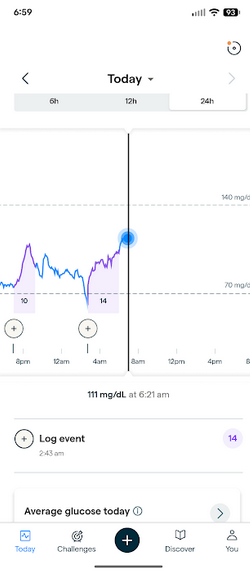
The high after 8pm is because I ate some of the last Valentine’s Day chocolate. The low at about 3am is likely due to my sleeping on the sensor, and the “event” that it has rated a 14 is due to my normal blood sugar rise in the morning followed by body weight training. So, you get “events” that are unrelated to food. I don’t know what to do with those, and it’s not like I can change anything to prevent this.