
Moving to induction


(Bob M) #1

This house has a gas cooktop that is…old. As in, installed in 1997. It has a downdraft in the middle of it. (Downdraft = there’s an opening in the middle of the cooktop and ducting that goes into the basement beneath the kitchen and outside.) Only two of the four burners worked, and it took FOREVER to boil water. So long we bought an induction single burner to boil water. (And we’ll use this as our sole burner until we get the new cooktop.)

We realized just a few weeks ago that they now make induction cooktops with downdraft. I took out the gas cooktop and got everything ready for an induction cooktop. We are having someone come in to see if the cooktop we chose can be installed.

Anyway, what’s the issue? We have so many pans that won’t work on induction:
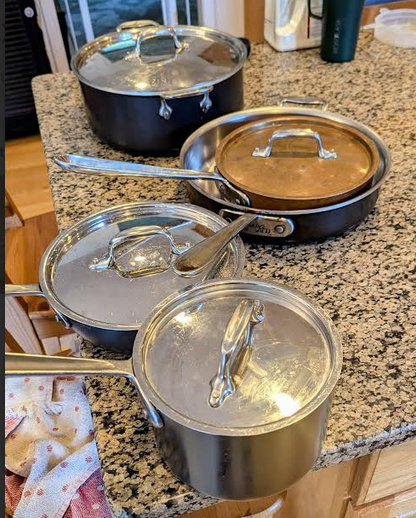
These are all All Clad cookware that we’ve built up over the course of decades. We bought single pans (with tops, which are usually extra). NONE of these work on induction.

Also, our nonstick pan (not shown) doesn’t work. Ugh!!

The research for a nonstick pan is complex, then add on top of that nonstick that ALSO works with induction, and it’s even more complex. I even asked Chat GPT about this. The main examples are Scanpan HaptIQ (on sale now at Williams-Sonoma), GreenPan Valencia Pro, Circulon A1, etc. The GreenPan is ceramic, but supposedly the non-stick doesn’t last long. There are PFAS (supposedly, “forever chemicals”) versions. And the Scanpan does have Teflon.

Since Williams-Sonoma has the Scanpan HaptIQ on sale now (you have to buy two pans though), that’s what I’m going to get.

Sizing is difficult, though. This is what we hope to get installed:
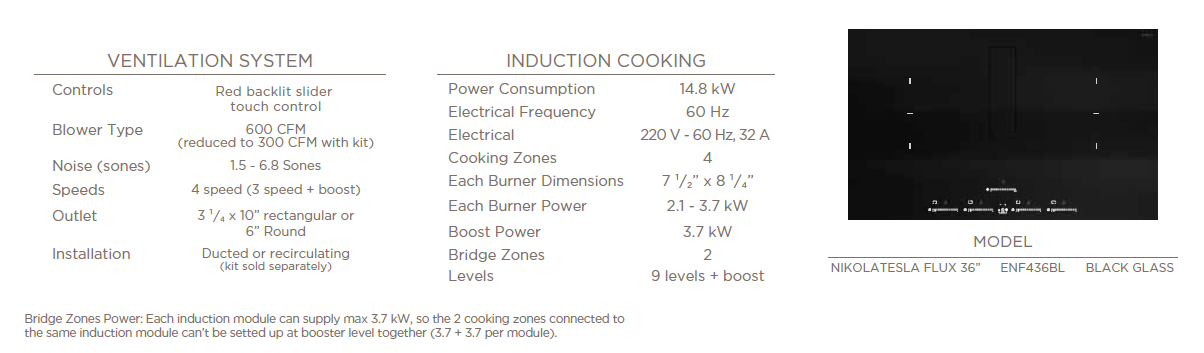
Each burner is only 7.5 x 8.25 inches, which makes me wonder how a 12 inch pan is going to get hot, and would ordering 8+10 inch pans be better than 10+12 inch pans? (The “bridge zone” means you can put a large, typically rectangular, pot on two burners. Not sure what would happen if you put a large round pan on it and tried to “bridge” the two burners.)

Anyway, I’ll report back later as to how the Scanpan is (we’ll use this on our single-burner induction), and what we think of the induction.


(Christian) #2

So I have here in Germany induction as well. The cooktop needs three phase current (360 V europe) and of course pans with a ferromagnetic layer. I love it and would never go back to other systems. The main advantages from my point of view:

  • it is extremely fast, I think even a little bit faster than gas
  • easy to clean
  • remains a life long beautiful black, no burn in of used water
  • perfect control over the heat, once you know the optimal value for your steaks, that’s reproducible and immediately available

I think it’s worth it’s price. I am using enamel pans from austrian company Riess and non stick pans (pfoa-free) from italian Aeternum (they call it “stone-layer”) . All these products can be found in US for example on Amazon.

Concerning sizes, usually you have a border around your cooktop. The pans must fit.
Concerning bridging: both fields need a ferromagnetic contact for at least half of their dimension to remain switched on. If that’s missing during bridging they stop. Bridging works for me as long as the contact is working.

Congratulations!


(Doug) #3

Seems quite familiar, Bob. :slightly_smiling_face::smile:

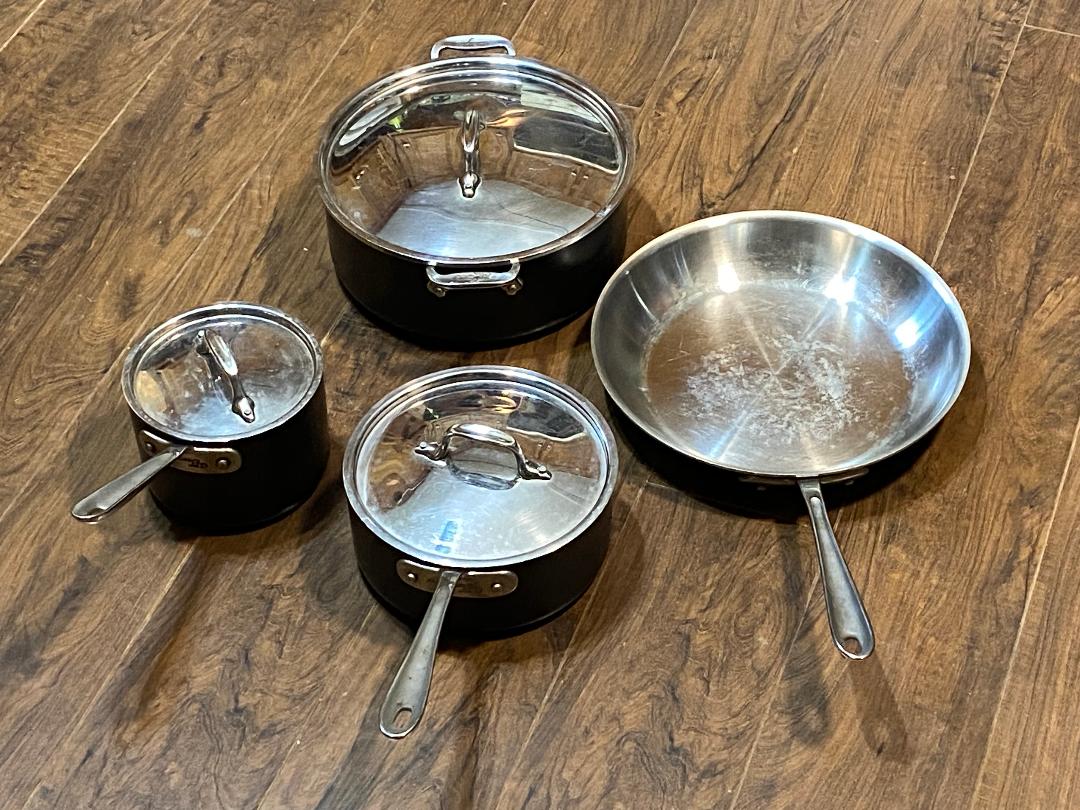
The All-Clad - we bought a set in the 1990s. The 4 shown and a smaller stainless steel frying pan, a medium-small nonstick Teflon pan, and something that I can’t remember and have no idea where it is…

The nonstick pan was good for a long time, but after 25 years had turned into a ‘Stick’ pan. :stuck_out_tongue_winking_eye::smile: We don’t use it anymore, and I’ve had thoughts of sanding off the coating, and resurfacing it or making it into just a metal-surface (whatever’s under the Teflon…)

Meanwhile, the modern ceramic-coated ones, even the cheap ones, do very well, at least for a while, in my opinion.

We also got a ‘Stanley Tucci’ pan, with “a laser-hardened Plasma Tech aluminum-titanium base and diamond-infused Thermolon ceramic coating.” Ain’t that a mouthful…? :stuck_out_tongue: It’s not cheap, but is great to use.

We’re also going to get an induction stove, and what pans will be required.

Smaller burners with larger pans - thicker pan metal is better than thinner, to better spread the heat out. Stirring more frequently helps, of course. Liquids or liquidy stuff in the pan does it better than drier stuff, of course.

The ‘bridging’ thing - should result in more heated area in a large round pan (the distance between the induction coils being the critical thing there).

To pre-heat a pan or with comparatively ‘dry’ stuff, thick stuff, etc, in the pan, I think it would be good to take it easy on the heat. Don’t slam the heat on High or ‘Boost’ right away - let the pan warm up some on lower heat settings before really cranking on it. Cold pan with high heat near the center but not all the way to the edges - could result in warping the pan.

That cooktop can definitely be installed at your place. It will need #8 wire and a 40 amp double-pole circuit breaker. As long as that fits in your breaker box and the overall capacity isn’t exceeded.

Here, I probably will need a new circuit breaker box or ‘service’ - 320 amps rather than 200.

That picture you showed of the Induction Cooking specifications has an error. The power consumption is not 14.8 kW. At the stated 220 volts, that would be 67 amps. :hushed: Whoever did that calculation took the 3.7 kW maximum for a cooking zone and just multiplied it by 4.

But the cooktop won’t send that much power to multiple zones. It automatically lowers it when more than one is being used, or when two are ‘bridged’ - to keep the total below the actual maximum, which is 7.7kW or 7.8.

What that picture shows for ‘Electrical’ is correct - 32 amps for 220 volts, would be 7.04 kW. At 240 volts - which I bet is what you have, not 220, it’s 7.68 kW.