Fish Oil and Increased Resting Metabolic Rate


(Edith) #1

Taking fish oil supplements at only 3g/d of EPA and DHA seems to cause an increase in resting metabolic rate and the amount of energy burned while exercising.

I’ve never been a fan of fish oil because I think it gives me heartburn, but maybe I can time it in such a way that it doesn’t. I think I’m going to give it a try.

https://www.nature.com/articles/0800451


(Bob M) #2

Some fish oil doesn’t give me heartburn, but you have to find one that doesn’t. This was was good for me:

https://a.co/d/5ckvc5d

I also bought some fish oil from Costco that was okay.

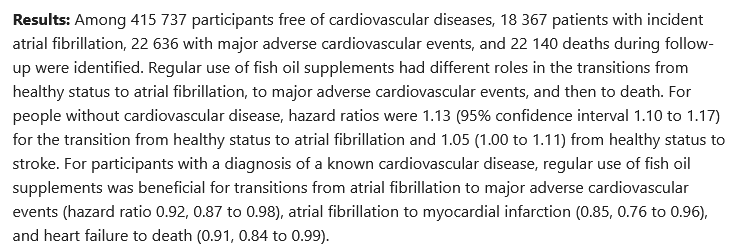
One caveat about taking fish oil. There’s some evidence that (higher amounts of) fish oil can cause atrial fibrillation:

https://www.ahajournals.org/doi/10.1161/CIRCULATIONAHA.121.057464

When I take fish oil, which isn’t that often, I keep under 1g/day.

Edit: I got sucked into a Black Friday sale and got some fish oil because I had to order a certain amount to get free shipping. I ordered minerals and D/K2, then ran out of things to order. So, I ordered fish oil. I’ll give it another try.

My “problem” with fish oil is that I don’t perceive a benefit. I could be getting a benefit (maybe lower inflammation for instance), but I can’t “feel” that. So, I take fish oil for a bottle, quit, and can’t tell a difference.

Even the study you cited, even if you get those benefits, they might be hard to tell. What does an increase in metabolic rate of 14% mean in terms of how you perceive this? That’s the hard part of n=1 studies.


(Bob M) #3

Looking backward, I did lose some weight, I think while taking fish oil (from Costco - not sure the dosage). I stopped taking it and got heavier again.

That’s the problem – we can’t really test something like metabolic rate.

Since I’m going to Costco tonight, I am going to see what they have. The version I bought from the online store has more DHA than EPA, which I’m not sure that’s what I want. It also has vitamins A and E. Not sure I need those. I’ll probably get whatever Costco has, which did not cause “fish burps” for me last time. We’ll see what happens this time.


(B Creighton) #4

That is because it lacks what it needs to make it easily absorbable. I use krill oil and calamari oil instead because they don’t have the mercury concerns, and I don’t burb them. Unfortunately my source of calamari oil is in ester form, but if you really want you could probably find the triglyceride form online. Calamariy oil is very high in DHA, and offsets the krill oil that way…


(Bob M) #5

I got this from Costco:

https://a.co/d/jkJUKuo

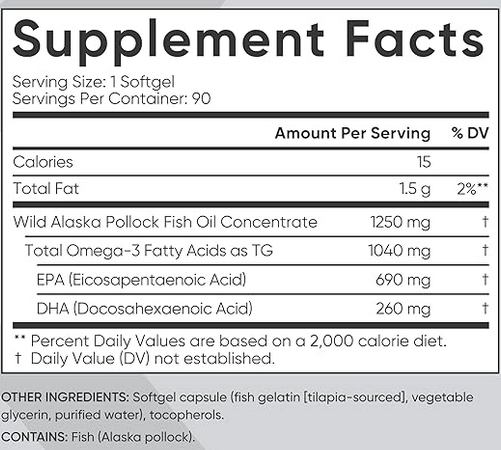
It’s slightly cheaper (by about 50 cents) at Amazon; HOWEVER, you get 150 pills at Costco and 90 at Amazon. That makes Costco much cheaper. My initial plan was to take one pill per day:
image

There is a relatively large amount of evidence that taking more than 1g/day could lead to atrial fibrillation. Of course, this is probably limited to some people and also it’s all related in relative risks, so I don’t know what the actual risk really is. I’ll consider taking 2 pills a day for a while, if I get time to do more research.

I’ve heard that krill oil is better, but it’s way more expensive to get the same amount of EPA/DHA.

This has a table of amounts to take for different conditions:

Not sure how true these are, and they don’t discuss atrial fibrillation at all. Here’s another study of the effects of fish oil:

The problem is that these are small hazard ratios (where above 1 = bad and below 1 = good). And they use epidemiological evidence, which is pretty much always crap.

And these studies are all done on people who aren’t eating low carb/keto (though there probably are people in the study doing this, but the vast majority are not).

When I got my O6/O3 ratio done a few times, it’s been “bad” according to the test place. But are those recommended values the same for keto folks? I doubt it.

On the other hand, Nick Norowitz said his O3 to O6 ratio is something ridiculously high, like 17 to 1.

Anyway, I took one of the fish oil pills last night after eating dinner, and got no fish oil burps or anything else.

(Ohio ) #6

Ok, I think you sold me on krill oil. I’m going to buy some and chime back in here. I feel like I’m more sensitive to the effects of o3. OR lack thereof. What do you recommend???

Thanks !!


(Harriet) #7

Fish oil used to repeat terribly on me. I buy enteric coated capsules, problem solved. The coating prevents the capsule breaking down in your stomach.


(B Creighton) #8

Well, first off I probably would not get some cheap no name brand off Amazon - probably processed in China - no guarantee of anything.
Second, as far as real krill oil goes, you won’t find as high a concentration of ingredients as fish oil, and if so, it is probably lying or more processed. Omega 3s like DHA are very fragile with 6 double bonds in the fatty acid, and are easily oxidized. Krill oil should come with its natural antioxidant astaxanthin. If it has been removed, it is more processed and probably more oxidized… so if no astaxanthin is on the label, I would avoid it. I don’t have a particular brand to recommend, but if you buy a new brand you haven’t used, squeeze one of the capsules open to smell the oil. If it is rancid, don’t buy or use anymore.
DHA oil(DHA from fish oil is processed enough that it won’t be lysoDHA which gives DHA a free ride through the blood brain barrier. Krill oil is better, but much is damaged in processing as well, so it is mostly free DHA. The best way to maximize lysoDHA is to eat unprocessed fish; to maximize the benefits of free DHA take it with phosphatidylcholine which is the transporter in lysoDHA ) - besides fresh fish, fish roe is another excellent source of omega 3s. Fresh squid/calamari is extremely high in DHA, and doesn’t have the mercury concerns that fish does. Sardines are another good source, because they are not up the food chain, and so haven’t concentrated the heavy metals. I eat whole sardines now rather than processed tuna, because of this and because the cooked, broken up tuna is a much more oxidized food - which exactly what you don’t want with these oils.


(Edith) #9

I happened to buy the brand you linked in your post. I’ve been taking one in the mornings for the past three days. So far, no heartburn or indigestion. I may try two per day to get to the quantities mentioned in the paper to see what happens, but I want to adjust to taking one a day first.

I’m not a big fan of seafood, but I have been trying to get it in my diet at least once a week. I tried fish roe. Even thinking of eating it as similar to taking a vitamin won’t get me to eat that again. :laughing:
I don’t mind sardines. I don’t think they taste bad but for some reason I have to psych myself up to eat them. I really should make sure I am eating them more. They are also a good source of calcium.


(Edith) #10

I just discovered this podcast with Ben Bikman, and what topic did he happen to cover?


(John) #11

While I do like to get omega 3 fats from cod liver and fish, I’m dubious about their being any effect on RMR or body fat loss. If the participants were eating margarine, or even butter or cream and then substituted it with fish oil, that alone could probably be enough to explain any fat loss. Having said that, omega 3 fats are good and, like I said, I like to include them in my nutrition. A great source for me is tinned cod liver packed in its own oil.


(Edith) #12

Actually, in the study they compared the effects of the fish oil to olive oil.


(John) #13

Ahh…I only saw that they replaced “visible fat” so assumed it could have been anything added. I couldn’t access the study’s methodology.


#14

On the heartburn, do other things give it to you? Think how small of an amount 3g is, it shouldn’t. If you’re prone to it, look at Betaine HCL to up stomach acid. May have an esophageal sphincter that’s not slamming closed hard enough.

Since I have my PhD in fish oil snobbery, go with Triglyceride form if you want to absorb it right, try to get something that’s IFOS certified as well. Without that, way too good of a chance it’s unchecked rancid crap. Krill is actually is a little better for absorption in it’s phospholipid form than fish oil.

Sports Research is the cheat code on that one, cheap, well known brand, and IFOS certified.


(Edith) #15

Luckily, I am not prone to heartburn.
So far, the Sports Research branch has not caused any trouble, but I am being cautious and not taking it too close to going bed.