
I wish they would have had some keto folks here, but that was part of the exclusion criteria (you couldn’t be on a keto diet). That’s too bad, because I would like to see what happened.
CGM = continuous glucose monitor
CKM = continuous ketone monitor
exo ketones = exogenous ketones, meaning you take them, and they are " ketone monoester supplementation" (and I forget the various types of exo ketones, but this is one of them)
Here’s the study:
https://www.sciencedirect.com/science/article/pii/S2589936825000672?via%3Dihub
I thought this was interesting:
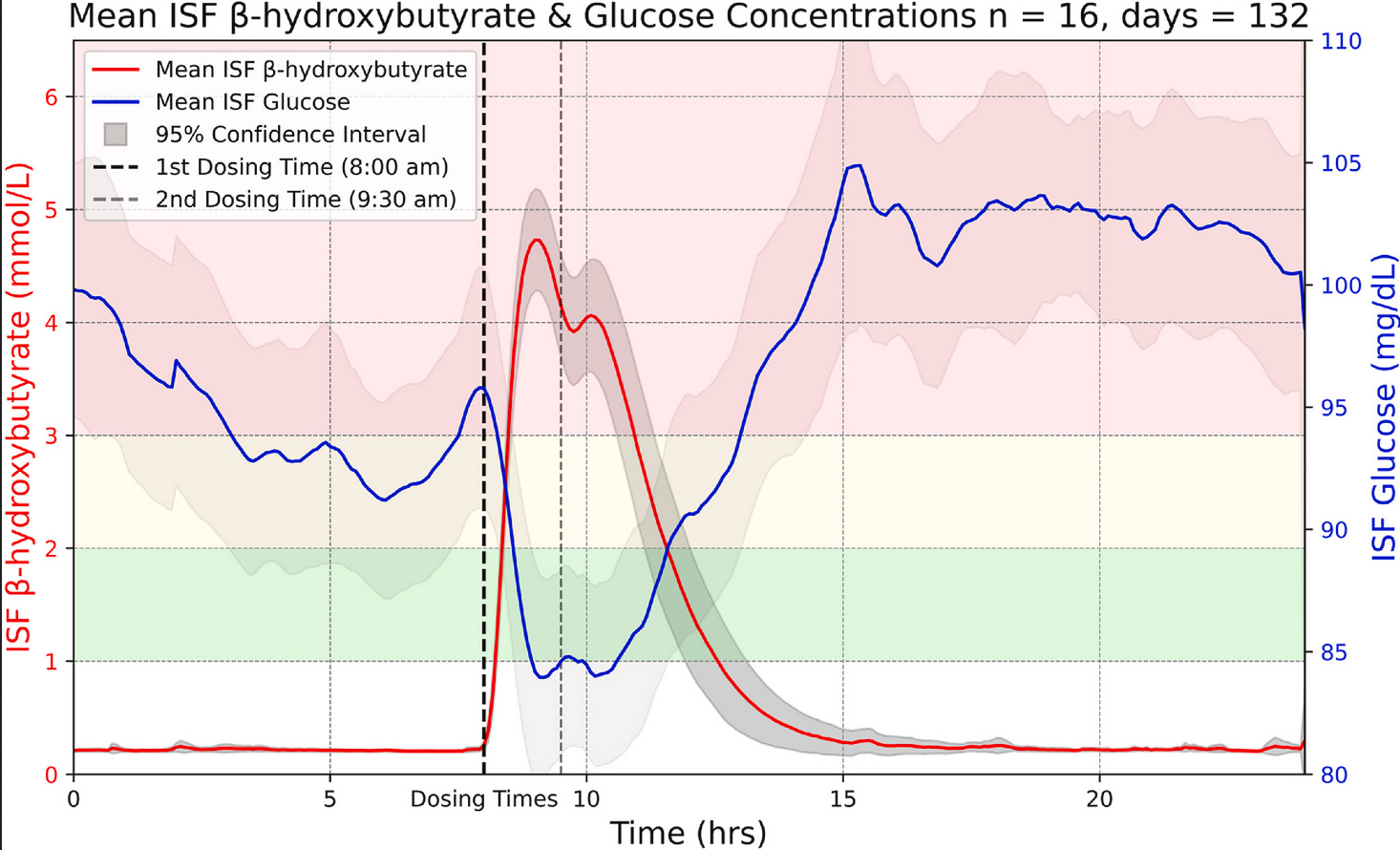
The blue line is glucose and the red line are ketones caused by taking an exogenous ketone drink. Their blood sugar gets suppressed. By 10 points, which is a lot.
This makes me wonder if there’s a similar effect for endogenous ketones (meaning, produced naturally by the body), because my blood sugar and ketones tend to be opposite: higher blood sugar = lower ketones; higher ketones = lower blood sugar.
In fact, I’m trying to figure out why I got much lower blood sugar in the morning for a while. Could be inulin (a prebiotic fiber that feeds gut bacteria); copper (I stared taking 2mg copper per day); or a “mousse” that was mainly coconut oils with some allulose. Or maybe some combination?
I’m thinking it might be the mousse, as coconut oils raise ketones, and possibly allulose, which supposedly lowers blood sugar. Still testing though.
Granted, this is also “exogenous”, as I’m eating it. But it would be nice to know if anything that causes ketones to rise (certain fats? lower protein?) would cause an equivalent lowering of blood sugar.