
The problem with N=1 studies


(Bob M) #1

So, there was a period of about 3-4 weeks where I suddenly had lower morning blood sugar (in the low 90s from 105-110) and high morning ketones (up to 1.5 mmol/l from around 0.3 mmol/l). I think whatever I was doing caused higher triglycerides, too, as all the sudden that happened. Oddly, it didn’t seem to matter what I ate either.

I was taking inulin, then started taking copper during this time. Not doing much else. I kept taking inulin and copper, but then stopping each for a while, and at some point, the effect went away. Completely. While continuing to take one or both. Blood sugar now 105-110 and ketones 0.3 again.

I have no idea what caused that.

My best theory is that inulin temporarily caused a change in my biome, but I can’t see how that would cause higher ketones.

And I have tried so many supplements where I can’t see any benefit. Could there be a benefit? Certainly, such as maybe lower whole-body inflammation, etc., but if I don’t have any blood tests during that time, I can’t find it.

(Joey) #2

I would speculate that anything that meaningfully changes one’s gut biome could produce digestive and metabolic effects that could lead to changes in serum ketone levels. I intentionally said speculate.

Frankly, serum glucose at these levels wouldn’t trouble me at all if the excursions in and around meal time were modest. If you’re seriously carb-restricted, those glucose levels are the ones your body is producing based on metabolic demand. Comparisons to (sickly) population average reference charts is just distracting.

And measuring scarce ketones once one is fully “adapted” remains a study in irrelevance. There’s no point in your body producing more than is required in the absence of dietary glucose sources. In fact, given a truly low carb context, the lower measured serum ketones, the more efficient mitochondria in your organs and other tissues must likely be. :vulcan_salute:


(B Creighton) #3

Yes. Inulin is known to feed one of the main probiotics, Akkermansia muciniphila, which typically makes acetic acid/vinegar with it. SCFAs seem to increase ketone levels. Soluble fiber has been shown to increase fat loss as well. Don’t know about the copper, but it is necessary for a few functions in the body. For instance, the enzyme needed to make melanin has 2 copper atoms.


(B Creighton) #4

I should add probably that that the SCFA, butyrate, seems to make the most ketones in the liver, but all 3 SCFAs, including acetate ie vinegar, can increase ketone levels. The thing with them though, is that the endothelial cells in the blood vessels like to burn them, so they simply just do not last long in the body. They are either burned directly for fuel or get converted into ketones for fuel. I doubt any make it more than 1 circuit around the blood stream. But, to answer your question more directly, yes, inulin supplementation is going to increase SCFA production in the gut, which in turn get sucked directly into the portal vein if not used by the colonocytes, and go up to the liver, which yes, can make ketones with all 3 SCFAs - acetate, butyrate and proprionate.


(Bob M) #5

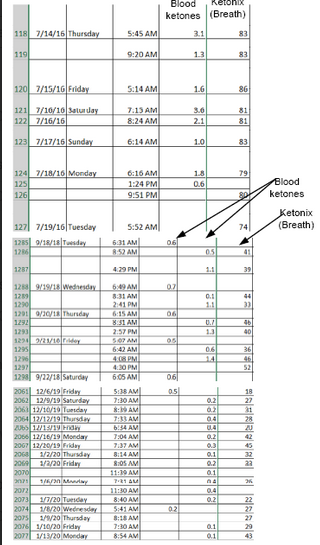
@SomeGuy I’m not that concerned about what my ketones are. Back when I was tracking these things, this is what I made:

You can see that, over time, my body settled on lower ketones.

I just found it strange that within a relatively short time, my blood sugar was – all the sudden – much lower and my ketones were much higher. And that lasted for about 3-4 weeks, then went completely away.

I’d love to know if it was inulin or copper or maybe both (or something else) that caused this. I was averaging 105-110 for a long time, and I happened to get my “official” blood test done during the time I was having lower blood sugar, and it was 91. 91! That’s about 15-20 points lower (and I took a pin-prick reading while I was in the parking lot of the blood testing place, and I got 94, which is pretty close).

I get looked at funnily when I have a blood test that’s 110 for an official blood test. So, if I could recreate it, I would sue this every time I got an “official” test done. (HOWEVER, my trigs were also high, which they flagged; I assume that was caused by whatever caused my blood sugar to be lower.)

@scaperdude I think you could be correct, or at least the only plausible explanation I have is that inulin caused certain bacteria to grow, which lowered blood sugar and also caused higher trigs. Almost like I was becoming more insulin sensitive and fat was releasing energy instead of keeping it, so my blood sugar could be lower, but my trigs higher.


(Joey) #6

Interesting stuff. Questions that, as you note, are hard to untangle when we’re exploring cause and effect on our n=1 selves. :man_shrugging: (Life is the ultimate confounding variable.)


(Susan) #7

Did anything else change? Sleep, stress, trauma (emotional or physical), change in exercise etc? Any of those can effect morning blood glucose and IR.