
Testing my theory that fat is (way) more important for ketones than protein


(Bob M) #1

I’m going to ask my wife’s sister, who lives overseas, to buy some continuous ketone meters (CKMs) for me. Once I get these, I want to put on both a CKM and CGM.

I have this idea, which seems to be true based on my testing, that fat matters A LOT more than protein for ketones. With a CKM and CGM, I’m hoping to test this.

My initial ideas:

  1. use both CKM and CGM for a while to see what is going on. Some of the CKM curves I’ve seen are wild.
  2. Next, keep protein the same every day while increasing daily fat content. Yes, I know calories will change, but I can’t really do anything about that. (If I change protein, I’ll change two variables.)
    3), Next, keep fat the same while increasing daily protein content. Again, I can’t change fat, otherwise there are two variables that are moving.

Does this sound at all reasonable?

Notes:

What I assume will happen is that (blood) ketones will be affected more by fat and less by protein.

One of the issues may be exercise. I might not exercise the same on each day. I’m assuming this will have something to do with ketones (and blood sugar). I’m assuming that since my blood sugar goes up during workouts, ketones will go down. It’ll be interesting to see if this is the case.

#2

Eager to hear about your results.


(Bob M) #4

Well, I’m asking my wife’s sister now to see if she’ll buy the SiBio continuous ketone monitor for me. Even if she buys it and sends it to me (instead of bringing it with her at Christmas when she’s coming to the US), it’ll take a while. You order it from Germany, it gets shipped to Sweden, then she has to ship it to me.

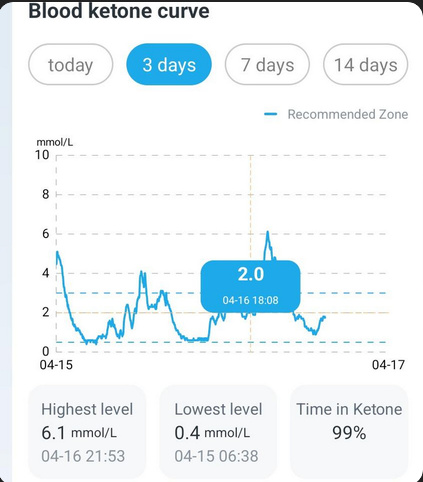
My fear is that the data will be so complex that it’ll be impossible to figure out what’s happening. Here’s someone’s ketone values:

image

That’s pretty wild. Would I see a difference with eating more fat or protein? I’m not sure.

As soon as I get the CKM (and corresponding CGM), I’ll report back.


(Central Florida Bob ) #5

This will be an interesting experiment to follow.

When I first saw this, I thought “sure, ketone levels depend more on fat levels than protein” but when I asked myself the followup question, “why do you think that?” I really couldn’t answer myself.


(Bob M) #6

The only reason I’m thinking this way is because I’ve been testing higher fat (mainly, saturated fat via cheese and cream).

Yesterday, I added some whipped cream on top of my chocolate “mousse” which is coconut-based. I then ate whipped cream by itself with dark chocolate chips (60%). My ketones this morning? 1.4 mmol/l, super high for me. And that’s with some 60% chocolate, so some carbs.

I often see/hear people say that low ketones are caused by eating “too much” protein. But I think it’s not eating “enough” fat. I ate shrimp last week, which is very low fat, high protein. I had no problems getting relatively high ketones in the morning because I was having 5% yogurt and I added 36% cream to that.

But the only way to really test it is to test it by taking data. The CKM would be fun to use, though possibly nullifying the idea. My guess is that a normal CKM “curve” would move upward with more fat and the same amount of protein per day. That is, each day with more fat but the same amount of protein would yield higher curves. But this is a guess.

But eating more protein while keeping the fat the same might not have as much of an effect. Again, it’s just a guess based on the feedback I’m getting where when I eat more fat, I get way higher ketones. I have not, however, taken any data, so maybe my protein is going down when I’m eating more fat? I don’t know.


(Central Florida Bob ) #7

I’ve seen mention of (and maybe a commercial for) a wearable that says it reads blood sugar without the pin prick. I think it was a smart watch. Of course that immediately raises the question of accuracy, but in the dream world it would be very nice to have something like the CGM that you stick on the back of your arm and let you track both blood glucose and ketones.

Gee, we’re complicated machines. So many variables interacting…


(Joey) #8

Since it’s likely that a (low carb) keto-style eater gets far more calories from fat than from protein, wouldn’t the dietary fat tend to generate a far greater component of one’s serum ketones? :thinking:


(Central Florida Bob ) #9

While I see that, how do I know they’re from dietary fat and not my body fat breaking down? (which I almost desperately want).


(Joey) #10

Don’t know… Except it may depend on just how much body fat is deemed “excess” by your metabolism.

When folks restrict caloric intake while in GLPs, studies seem to indicate more muscle is lost than body fat. So many variables coming and going. :man_shrugging: