
Someone who quotes Drs Greger and McDougall is never going to be an advocate of meat eating. Both are quite forceful vegetable diet proponents. I would take it with a large pinch of salt…
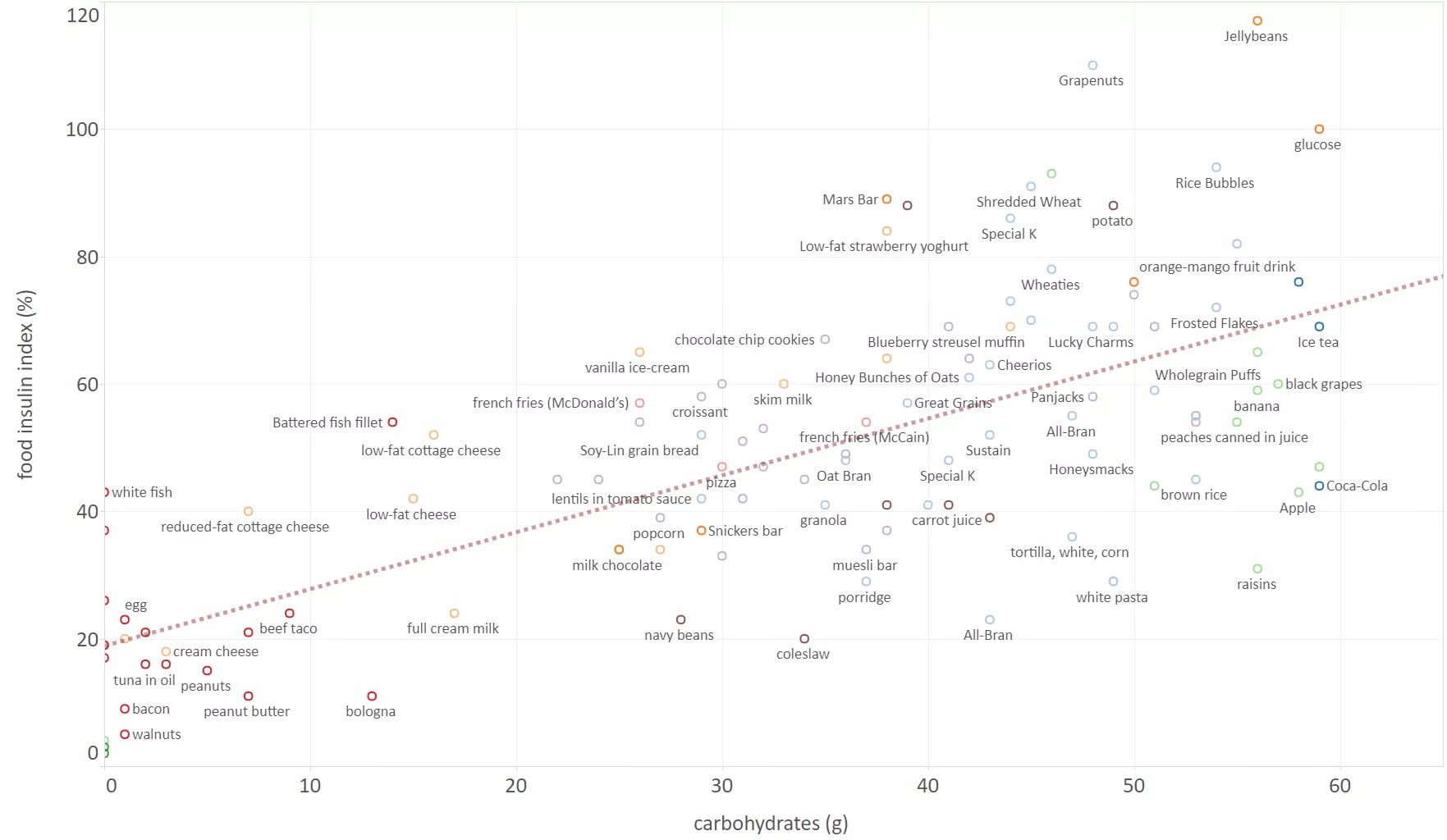
Insulin index chart
Bahrutile
(Dustin Cade)
#8
My understating of insulin response is it will lower over time with low glycimic intake such as a keto diet. Where at the start with anything we put into our stomach will intact a over responsive amount of insulin as it’s needed to be high for a long period, though with continued adherence to a low glycimic diet the response will normalize… at least that’s what I’ve taken away from what @Richard has said… i could be very mistaken though.
Marty_Kendall
(Marty Kendall)
#9
The most comprehensive list of food insulin index data is the appendix to Kirstine Bell’s University of Sydney thesis.
DVMO
(DowskiVision MagicalOracle)
#10
McDougall is clinically insane. He outright, not-ironically, touts sugar as a cure for diabetes! https://youtu.be/UgE2IdL6tMw (60 minutes into the video).
cwstnsko
(Chris W)
#11
I know it’s an old thread, but related to the insulin index topic, Dr. Benjamin Bikman gave an excellent presentation at Breckenridge that led me to believe that insulin response is not as simple an a fixed index number, but can be quite different in the context of limited glucose than it is in the context of a “balanced” diet. In my mind, this brings in to question the validity of the historical insulin index data in the context of a very low carb ketogenic diet, specifically the data in regards to insulin response to protein.
dub
(Boston_guy)
#12
Can’t believe peanut-butter is down there at the lower-left. Think I’ll mix up some bacon bits with peanut butter! (src: optimizing nutrition)
EZB
(Ethan)
#13
According to the number of carbs, we really shouldn’t be eating anything outside that lower-left box anyway. It’s interesting that eggs are above that, but it’s close enough. Also, what kind of serving are they using? Since when does bologna have 13 or so carbs?
dub
(Boston_guy)
#14
@cwstnsko Think this is the talk you were mentioning – about glucagon/insulin ratio. https://www.youtube.com/watch?v=z3fO5aTD6JU
cwstnsko
(Chris W)
#15
Yes, that is the presentation. It’s nice that it’s on Youtube now for those who don’t have a Diet Doctor membership, who have already used up their free trial.
nearing
#16
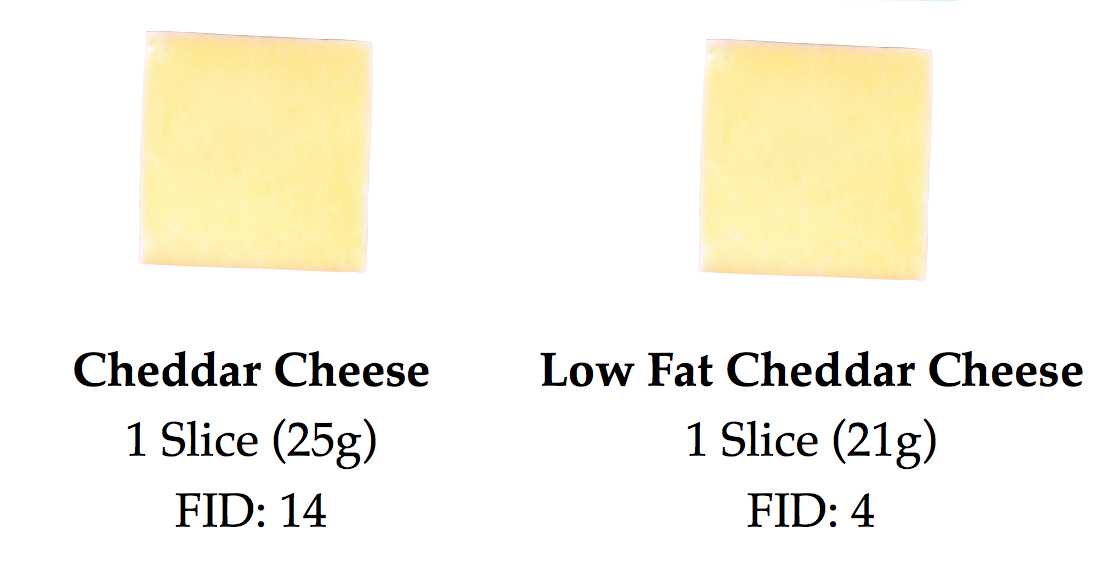
Marty, can you explain this? Why would the full fat cheese have higher Insulin index than the low fat one?
Marty_Kendall
(Marty Kendall)
#18
the food insulin index testing was done with 1000 kJ portions of each of the foods.
Marty_Kendall
(Marty Kendall)
#19
@cwstnsko the Bikman presentation is really good. TL;DR, there is no need to fear ‘too much protein’ because of insulin. The insulin response to protein is balanced by the glucagon response.
EZB
(Ethan)
#20
I declare BS on the bologna then. 1000 kJ is about 240 Calories. 240 Calories of bologna is NOT 13g of carbs.
akirby83
(Adam Kirby)
#22
I’m not actually sure that’s true in light of Jimmy Moore’s 3:1 protein experiment where he felt like crap and got reactive hypoglycemia. I think we have to be honest and say that too high of a protein intake can have negative effects. It might not necessarily be the fear that people have, being “kicked out of ketosis”, but still considerations to be had. And in Jimmy’s case it was frankly an absurd protocol (not blaming Jimmy, the protocol itself is not a natural eating pattern).
Marty_Kendall
(Marty Kendall)
#23
I found it interesting that his fasting insulin dropped from 14 to 8.8 after five days and then bounced back up to 18 after two days of high fat re-feeding before the final labs were done. This post was inspired by some discussions Jimmy and I had during the experiment.
I’m not advocating an abrupt change from high fat keto to 3:1 protein:fat for only 7 days, but I think focusing on nutrients over ketones without avoiding protein for fear of it raising his glucose (which it didn’t) would be a good “biohack” for the future.
Seems this one was set up to fail. 
Marty_Kendall
(Marty Kendall)
#24
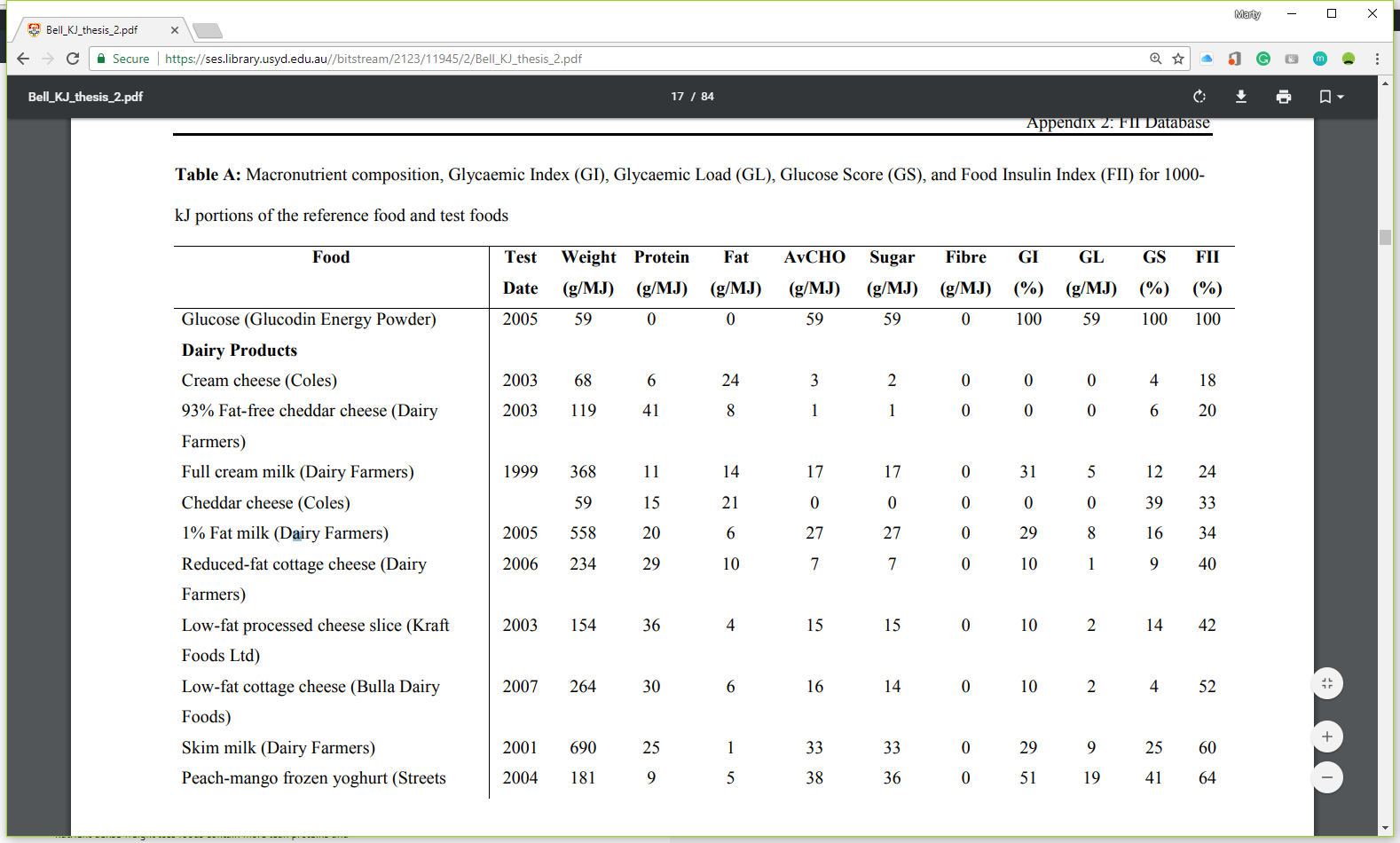
@nearing I can’t see those results in the data tables in the appendix from the testing?!?!
nearing
#25
At the end of the thesis, can’t remember which pdf, she has a booklet for consumers - it’s there.
I screenshotted it.
gingogenic
(Ginger)
#26
The problem with the insulin index is that the mix of food types in a meal will likely change the insulin index result, just like it does with the glycemic index.
With the glycemic index, a higher fat content lowers the overall glucose load (ie butter all over the bagel is going to spike glucose less than low fat spread). I think it’s fair to assume that insulin response might behave similarly.
We really need research on the insulin index of meals rather than single foods because in reality this is what our bodies are dealing with. My guess would be that the fat content in a meal will reduce the insulinogenic affect of protein greatly for instance (ie a whole egg will be less insulinogenic than the eggwhite on its own).