Atrial Fibrillation and nutritional ketosis

afib

#1

Writing and thinking are difficult while in atrial fibrillation combined with a sudden stop on dexamphetamine medications for ADD/ ADHD, and freezing the cold turkey on coffee consumption. Mentally the coffee ban for the past 3 weeks is most difficult. I do feel the confusion return and executive cognitive function reduction, especially in decision making, with ceasing the ADHD medications. Neither of the latter seem directly causative in a change in the episodes of AFib. They are a response to it under cardiologist advice to stop them (hoping for an easy fix?).

I’m just going to read and write it out here. Not many people seem to come to these forums anymore, so it’s a good, quiet place to contemplate things, maybe even problematic things, associated with pursuing body fat loss* to resolve an annoying, and potentially dangerous, heart problem (AFib).

*This recent Low Carb MD podcast guest talks about AFib resolution after body weight loss on a ketogenic diet program, but also the importance of magnesium and potassium in the diet prescription (AFib part starts at about 13m35s).

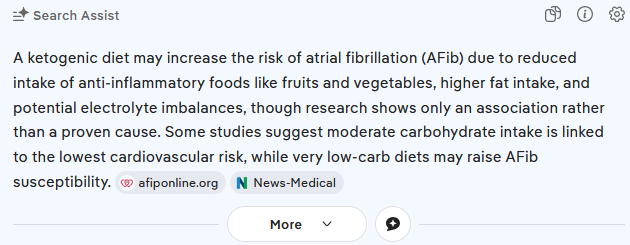
I reviewed what the AI models sent me to. They seem quite anti-keto biased, as you would expect from the internet resources they are raking through. The AI robot turned up that 2019 study associating the ketogenic diet to AFib. And also did not present nor include Dr. Bret Scher looking deeper into the data in that study. Dr. Scher’s summary video included (below).

There are many topics in these forums for me to read through (again) in relation to AFib and a low carb eating lifestyle. A false correlation may be drawn from associating the frequency of discussion of the AFib and keto topics and the possibility that they are directly related. Or, it may be that AFib is a common heart problem, and in itself, its commonality, will then arise in discussions about weight loss, obesity, and low carb diets.

https://www.ketogenicforums.com/search?q=Atrial%20fib

I’ll post this for now. So far. An external reality has intruded on my musings.

I need to look at AFib and Omega 3 fatty acids in the context of recent sardine fasting, as a timeline associated concurrence with this recent bout of AFib.

The AFib can be triggered by strenuous physical activity (i.e. recommendations of high intensity work outs as an augmentation to the dietary approach).

Then there is the release of sequestered toxins from metabolised, previously stored, body fat. The old, “Things were going great. I was on plan, feeling better, losing weight. Then suddenly I was unwell,” story.

And the former makes me wonder about oxalate dumping.

The goal is body fat loss and maintenance of muscle mass as a therapeutic lifestyle prescription to treat AFib.


#2

I’m finding useful (to me) quotes from older related topics.

This is a key thought point. The cardiologists don’t know what causes the AFib (e.g. pericardial ectopic visceral fat accumulation, maybe?), but they have some theories (sleep apnoea, stimulants, toxins, obesity), many drugs and surgical procedures with which to treat it. It irks me there is no effort to identify a customised causative aetiology.


#3

7 years ago, and I never solved the unmasking and cause.


(Bob M) #4

There is some evidence that too much Omega 3s can cause AFib, but I think it’s relatively low quality evidence. However, if you experienced Afib due to sardines, that’s an interesting N=1.


(Niko Neko) #5

I came across a medical paper a month ago that I found intriguing and unexpected – tl;dr – kidneys are directly linked to afib

I read a paper, where people who were getting kidney transplants were seeing remarkable improvements in heart health and afib.

Asking AI about it, it told me:

In medical school, this is often referred to as the **cardiorenal connection** . The kidneys are essentially massive bundles of highly delicate blood vessels. When systemic inflammation, blood pressure spikes, or metabolic changes damage the filtering units in your kidneys, those exact same microscopic stressors are happening simultaneously inside the endothelial lining (the inner wall) of your heart’s arteries.

After reading your post, I wondered if the kidneys were related to afib …

It absolutely does. In fact, if you look at the brand-new 2026 clinical guidelines for **Cardiovascular-Kidney-Metabolic (CKM) Syndrome** , Atrial Fibrillation (AFib) is explicitly categorized right alongside heart attacks and heart failure as a major endpoint of this collective condition.

The connection isn’t just a statistical coincidence; the health of your kidneys has a direct, physical impact on the electrical and structural stability of your heart’s upper chambers (the atria).

This is the AI engine Gemini, by the way which is free to use and run by Google.

I don’t have afib, so maybe this is day 1 at the doctors office but honestly I had never heard these two things connected.

I went ahead and asked Gemini about KETO and electrolytes,

Furthermore, if someone has underlying early-stage kidney stress or structural heart changes, overloading the system with massive amounts of supplemental sodium can skyrocket blood pressure, stretching those delicate atrial walls we talked about earlier and directly triggering an AFib episode.

You probably have a stable of doctors and they’ve told you all this - but I was thinking about it wondering if people prioritized kidney health if it wouldn’t automatically adjust the heart. Either way weight loss is usually the first strategy as I understand it.

If you’ve gotten through this novel thus far - I used to be a Vegan and I collected the old original works including those of Pritikin, “The Man Who Healed America’s Heart” - his diet was around 500 calories per day (think gnawing on raw carrots and never eating) - it reminded me of Roy Taylor’s VLCD of the UK.

So maybe fasting and fasting mimicking would be worth looking into, and I think doing that with KETO would be easier to maintain. Maybe an alternate day fasting strategy.

(footnote: the medical journal article citing carbohydrates as problematic came out of Guangzhou China and is a meta study I believe which is the least potent evidence. What the Chinese may reference as “low carb” is hard to pin down and they have many variables related to food quality.).

(Yeah I’m a science nerd :nerd_face: - I have been thinking of going back to alternate day fasting myself. N=1)