
As you acknowledge that the weight lost in the first few weeks was mostly water I’m wondering if this is not a stall at all - apart from a stall in losing water. Perhaps this is a period where you’re body is going through changes, getting used to a different form of fuel and is preparing to begin burning & shedding fat? Could looking at this differently remove or reduce frustrations associated with a perceived stall? Or would it be just as frustrating to think, when will fat loss begin? Plenty of great advice above either way.
Almost two months in, after 20lbs of weight loss, massive stall
larry
(Larry Lustig)
#22
So, I googled this issue of low-carb diets causing memory loss and found one study. I’m not sure that this is the study referred to by @gttechlife since that is stated to be double-blind and this one isn’t even randomized or single-blind.
Here is a write-up of this n of 19 study:
The results state that after one week low-carb dieters performed worse on two of three measurement categories and better one on category. This corresponds to the period during which we’ve all come to expect hormonal disregulation (eg, the keto flu) in a substantial percentage of people pursuing a ketogenic diet. For whatever reason, the study then added back some amount of carbohydrate (it’s not specified how much) to the low-carb group and noticed improvement in weeks two and three. The study did not go past three weeks.
There are quite a few problems with this study. Firstly, it seems pretty clearly designed to prove the thesis that exogenous glucose is necessary to for brain function. Secondly, it probably involves subjective judgments (hard to tell from the link exactly how “memory” was measured) and wasn’t blinded so the measurements were made with full knowledge of which group was being measured. Third, the experiment ran for a very short period of time. Finally, the protocol followed was such that, if one were to design a study with this specific outcome in mind, it couldn’t be done better.
larry
(Larry Lustig)
#23
And here is a considerably better study which I haven’t read through entirely, but which appears to show no significant difference in cognitive functions between LC and LF diets after eight and fifty-two weeks (although mood was found to be better on low fat after one year):
gttechlife
(gttechlife)
#24
Great sources Larry.
Good news, the stall is over. Down another 2lbs as of this morning. Went extra hard in jujitsu last night. I’m definitely going to stay the course in keto, but I think activity level is equally important.
Thanks for the tips everybody.
Adam
(Adam L)
#26
Do you use any other unit of measurement for progress/success/stalling apart from lbs? How about waist/stomach or other body measurements, blood sugar, blood ketones ? If the scale doesn’t move some days or weeks maybe positive feedback from one or more of these other measurements would give you confidence that what you’re doing is working. I have been “only” 290lbs at my heaviest & know that I could have lost 2lbs on the scale in a day via pee, sweat or other bodily functions which is why I don’t regard scale weight as the main or best measure of progress for me - though it’s certainly a part of the equation. Good on you for committing to stay the course, I hope you have great success with keto.
Groversaurus
(David)
#27
I can lose / gain 2 lbs just by moving my scales from one part of the bathroom floor to another.
This morning I used 2 sets of scales 10 times, and got 9 different weights. Varying from 115.1 to 116.8 Kg
MarkGossage
(bulkbiker)
#28
I did an experiment yesterday weighed myself when I got up 228.2 pounds
Did the bathroom thing then 227.0 pounds
Went to gm and swam 1.35km sat in steam room got home and weighed 225.4pounds
Almost a 3 pound variation in under 3 hours ate nothing and drank a black chinese tea
Adam
(Adam L)
#29
Exactly, so when the poster weighs 350-355lbs loses 2lbs and declares, “good news, the stall is over” I have to wonder. I mean I really hope the stall is over for that person but is a 2lb scale weight loss how you measure that? Say the person drinks water like a fish & put on 3 lbs in a couple of days, are they stalled again? If progress is to be measured in such micro units it might help to see two or more types of measurements moving in the right direction.
Groversaurus
(David)
#30
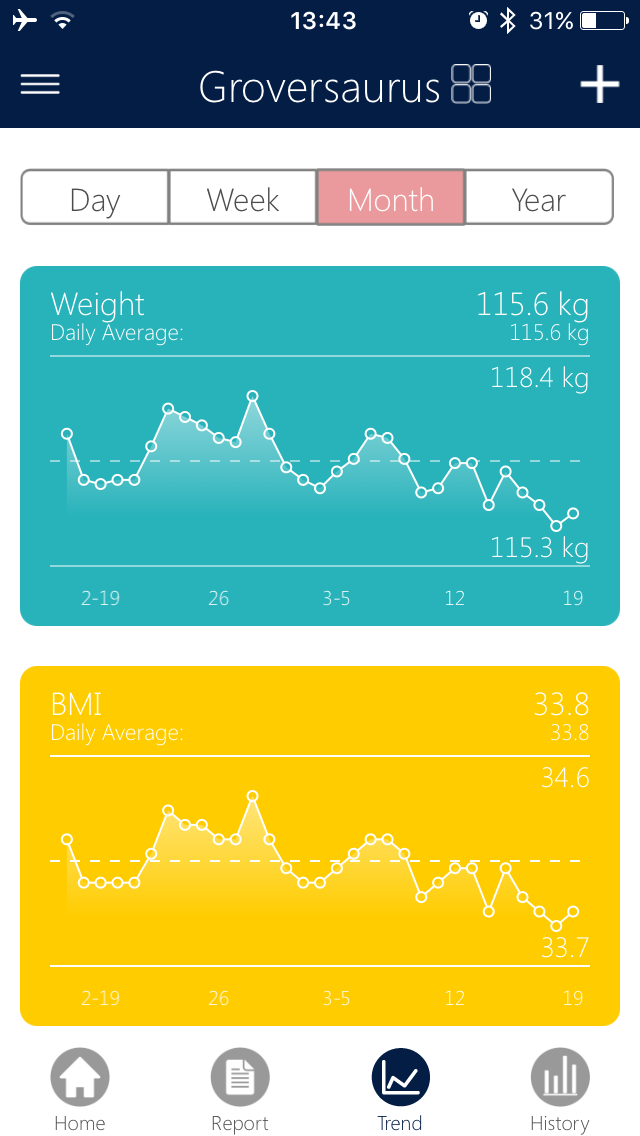
My weight is up and down like a Bride’s nightie but the general trend is downwards. At least, that’s how it looks to me.
Dan_Dan
(Dan Dan)
#32
I disagree this was a poorly done study 
A big problem with the study is they assume a diets health benefits is based mainly on calorie restriction.
“Background Very low-carbohydrate (LC) diets are often used to promote weight loss, but the long-term effects on psychological function remain unknown.”
“approximately 1433 kcal/d for women and 1672 kcal/d for men”
Another big problem was casual supervision and very little support
“The participants met individually with a qualified dietitian fortnightly during the first 8 weeks of the study and then monthly thereafter; the dietician provided detailed individualized dietary advice, meal plans, and recipe information pertaining to each diet. To facilitate dietary compliance, the participants were supplied with a selection of key foods (approximately 30% of total energy) that were representative of each diet’s macronutrient profile fortnightly for the first 8 weeks, and then a A$40 food voucher was provided at each monthly diet visit during the remainder of the study. Both dietary patterns were also structured to include specific food quantities and weights to ensure that the correct macronutrient and energy requirements were achieved as previously described.”
And yet another big problem is very poor methodology
“In the morning after an overnight fast, body weight and mood were measured at baseline and at weeks 8, 24, 40, and 52.”
“How have you felt over the past week, including today?”
“38 withdrew throughout the intervention, and an additional 3 participants did not complete the mood and cognitive function assessments at the end of the study at week 52”
The biggest problem is not enough data points
How do you track trends for a year long study with only 5 data points 